

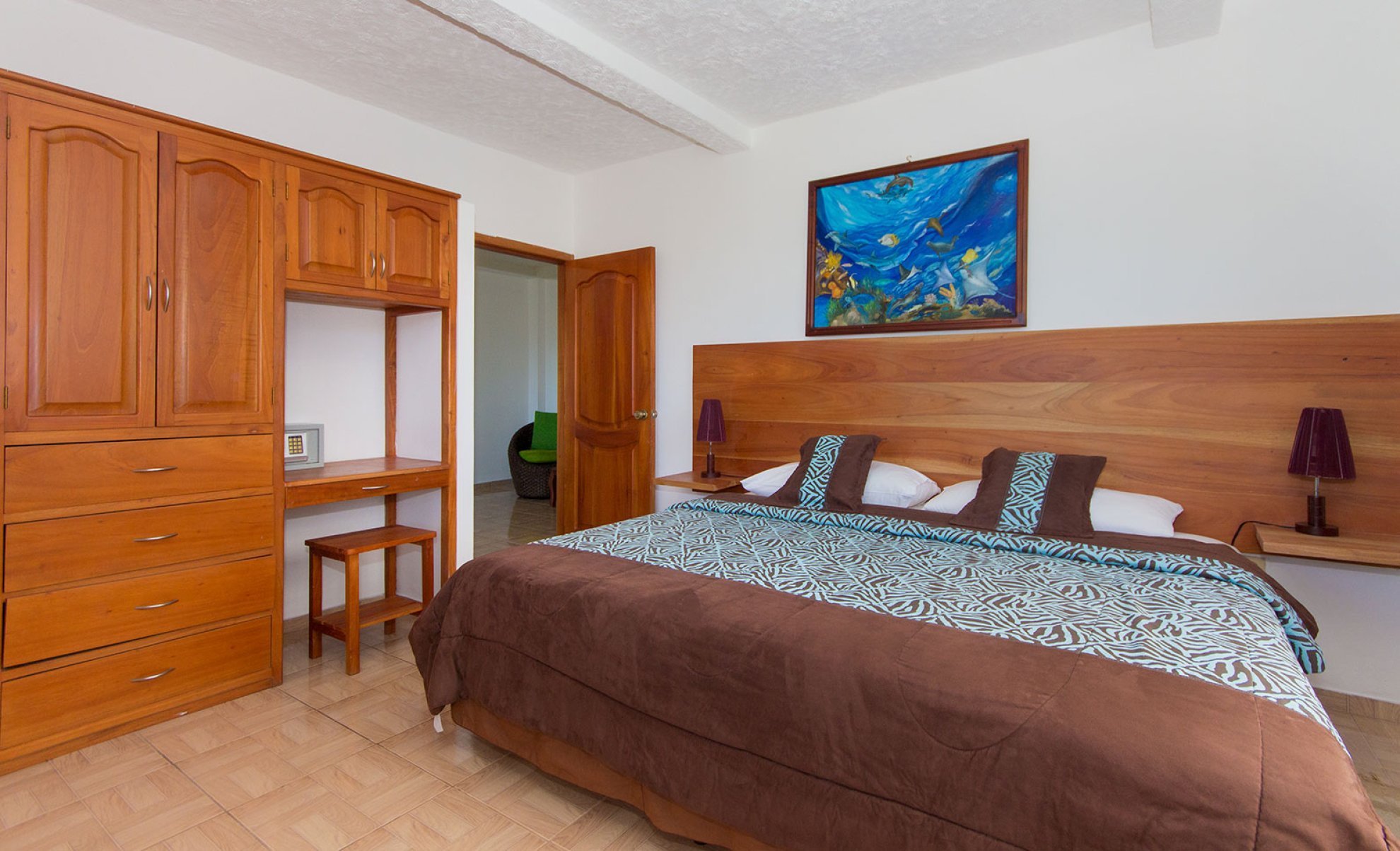
Hotel Twin Lodge Galápagos
About Hotel Twin Lodge Galápagos
Contact information
Hotel Twin Lodge Galápagos
Puerto Ayora, GalápagosLocation map
Opening hours
Is this your business?
Claim this listing to update its information and reach more customers.
Claim listingNearby attractions
Places to visit within 30 km.

Tortuga Bay
Tortuga Bay is located on the island of Santa Cruz in the Galapagos, Ecuador. Puerto Ayora is around 20 minutes on foot. There is a small road 2,500 meters long and you must start and close session in the office of the Galapagos National Park, when access to Tortuga Bay is granted to visitors free of charge. The beach is perfectly preserved and with the presence of wild animals such as iguanas, beach crabs. Only swim in the mangrove that is separated from the beach. In the mangroves it is very common to find multicolored walking crabs (Grapsus grapsus), brown pelicans (Pelecanus occidentalis), marine iguanas (Amblyrhynchus cristatus), white tip reef sharks (Triaenodon obesus) and Galápagos tortoises (Chelonoidis nigra complex). Tortuga Bay is a white sand beach located on the south coast of the island of Santa Cruz . Turtle Bay or Turtle Bay is as it appears in the old maps of the islands. The bay is accessible through an improved road from the southwest side of the city and is a popular destination. The walk in the sun is rewarded with a spectacular white sand beach that stretches along the south coast of Santa Cruz. The beach of Tortuga Bay is famous for its extensive and pristine coastline that gradually descends towards the resplendent Pacific Ocean. It's a great place to try your hand at surfing or just relax and sunbathe with the marine iguanas you'll find on the beach. To discover all the richness of Galápagos marine life, you can snorkel in its crystal clear waters. You can see colorful reef fish, white tip sharks, rays and the name of the beach, sea turtles. You should take some time to walk through the Iguana Marine Sanctuary , where you can also take a look at the blue footed boobies and frigates along the coast. Marine life in Tortuga Bay Reef and pelagic fish, sea turtles, rays, white tip reef sharks, Sally Light-Foot crabs and many other species are those that you will be able to appreciate and discover in the crystalline waters that this place offers. Terrestrial Fauna in Tortuga Bay Sea turtles that go to that place and lay their eggs. Other species that can be found here are pelicans, Darwin's finches, cucubes, pigeons and marine iguanas, frigate birds, blue-footed boobies and other birds. The tour of the place can have a moderate to strenuous difficulty (due to heat and exposure). The paved path with some stairs and small hills has a distance of approximately 2.5 kilometers in each direction, you can travel in a time of 30 minutes on foot to the first beach and 25 minutes more to the bay. What to do in Tortuga Bay Walk to the beach through forests of cactus, palo santo and matasarno trees. Stroll along the pristine white sand beach. Snorkel in one of the lagoons in the area. Look for the sea turtles that are fishing in the waves along the Iguana road. Walk through the sanctuary of Iguana Marina and the cactus forest. Take $ 20 to rent a kayak and search for marine life. Tourist information about Bahía Tortuga It is a bay divided into two inlets that give rise to the conformation of 2 beaches, the first called Playa Brava and the second called Playa Mansa; the origin of the name is due to a sea turtle nesting site. During the walk along the access path, there is vegetation from the lower part of the transition zone, as well as from the dry zone and the coastal zone. Between the two beaches there is a circular path that runs through the intertidal zone and crosses a forest of tuna and ends a mangrove which is the beginning of the beach mansa. How to get to Turtle Bay There are 2 ways to get to the site, by sea by means of water taxis that leave the passenger pier of Puerto Ayora and by land through a path of about 2 km that connects the port with the site and that only You can walk walking. Being part of the Galapagos National Park the time of departure is at 6pm so from 5pm you hear the whistle of the park ranger who comes to remember that it is time to leave paradise. To get to Tortuga Bay it is not necessary to hire a tour or guide. The taxi ride to the entrance of the park costs on average USD 2 or you can also walk from the city center for around 40 minutes. Climate in Tortuga Bay It has 2 seasons dry season and garúa from June to December. Temperatures vary between 18 and 20 º C. The hot and rainy season is from January to May. Temperatures vary between 24 and 29º C. Turtle Bay according to a list published by TripAdvisor, positions it among the 10 most beautiful beaches in the world and South America. World Top Ten Baia do Sancho (Brazil) Grace Bay (Turks and Caicos Islands) Eagle Beach (Aruba) Playa Paraiso (Cuba) Siesta Beach (Florida, USA) Beach of La Concha (Donostia, Spain) North Beach (Isla Mujeres) Radhanagar Beach (Havelock Island) Elafonisi beach (Greece) Tortuga Bay (Galapagos, Ecuador) Top Ten South America Baia do Sancho (Brazil) Tortuga Bay (Galapagos, Ecuador) Anakena Beach (Easter Island, Chile) Carneiros Beach (Brazil) Forno Beach (Brazil) Farol Beach (Brazil) Prainha Beach (Brazil) Cavancha Beach (Chile) Crystal Beach (Colombia) Mansa Beach (Uruguay) Recommendations when traveling to Tortuga Bay There is not any kind of shop or restaurant in the Park, so it is advisable to bring food to snack and plenty of water or moisturizing drinks. At the point of entry they sell some products, but they can cost double what they are worth in the city. Collect the garbage and deposit it in the places indicated for it. Do not feed the animals in the sector. Do not destroy the flora and fauna of the sector. Help protect the environment Do not forget to take your Photo Camera to cover those unforgettable moments ..!
7.91 Km.

Galapagos National Park
The Galapagos National Park (PNG) is a national park of Ecuador. It was founded in 1959 and became the first national park in the country. It covers about 7,995.4 km², 97% of the land area of the Galapagos Islands considered by experts and scientists as the best preserved volcanic archipelago in the world. The natural beauty of the islands, the diversity and uniqueness of the species it hosts, its volcanic origin, its geological dynamics with permanent changes and variety of formations; Being considered a living laboratory of evolutionary processes still underway, added to the fact that it allowed for the development of a large number of both animal and plant species that do not exist anywhere else in the world, make Galapagos a very unique place and of global importance for the common heritage of humanity. The endemic and native flora and fauna unique in the world, make the Galapagos Islands an exceptional place. More than 45 species of endemic birds, 42 reptiles, 15 mammals and 79 fish, live in Galapagos and coexist harmoniously with humans. The Galapagos Islands also have a rich variety of endemic flora, reaching 500 species among vascular plants, bryophytes and algae. The most representative species of the Galapagos National Park are the giant tortoises, which give their name to the archipelago. Initially there were 15 species of turtles, but the human predation of which they were victims in the eighteenth century by pirates and whalers, caused the extinction of 3 species, and the constant eruptions of the volcano La Cumbre, in Fernandina also ended the species of this island, naturally. In 2015, scientific studies at the genetic level identified a new species of giant tortoise, Chelonoidis donfaustoi, confirming that the Galapagos National Park is a living laboratory. The Galapagos National Park is one of the two protected areas that exist in the Galapagos Islands. The other is the Galapagos Marine Reserve, both protected areas are managed by the Directorate of the Galapagos National Park, according to the Organic Law of Special Regime for the Conservation and Sustainable Development of the Province of Galapagos. Extension of the Galapagos National Park It has an area of 799 540 ha, occupies 97% of the total extension of the islands, excluding those inhabited by Santa Cruz, San Cristóbal, Isabela, Floreana and Baltra. Birds of the Galapagos National Park Galapagos hosts numerous genera and species of land and sea birds. Millions of years ago, migrant birds arrived on the islands and the adaptation processes modified the species, differentiating them from those of the continent. The pink flamingos that are surely the most beautiful birds that arrived on the islands are striking. Also striking are the Galapagos penguins, sea lions, Galapagos iguana (land), marine iguana, sea turtles, fish, the hammerhead shark, dolphins and whales, Galapagos finches, albatrosses, frigates and blue-footed boobies in Galapagos . Flora of the Galapagos National Park 220 genera of endemic, 399 native and 119 introduced plants have been registered in the Archipelago. The area is surrounded by cacti, holy sticks, carobs and lichen. In the low humid zone, large ferns and other evergreen varieties grow (matasanos, cat nails, horse knees, among others). In the high humid zone (between 200 and 500 m high) grow the guayabillo, passionflower, coffee, mosses, fungi, huicundos, among others. The guava tree or other species of the Andean moor abound. Passion Flower: This is another plant endemic to Galapagos. The flowers of this plant are white. Vegetation Areas of the Galapagos National Park From the coast to the highlands, five zones of vegetation have been defined in Galapagos. Coastal Vegetation Zone of the Galapagos National Park The coasts are saline, and so the plants that live here have physiological characteristics that allow them to survive hypersaline conditions. As classic representatives we have the Red Mangrove and its spectacular aerial roots, the Monte Salado and the Morning Glory. Arid Vegetation Zone of the Galapagos National Park The territory of the Cacti! The great and famous Opuntia cactus (the prickly pears) inhabit this area as dominators of the land, and provide food for vertebrates such as turtles and land iguanas. The elegant Candelabra cacti, belonging to the Jasminocereus genus, complement the newest lavas that house the lava cactus (Brachycereus genus. Another classic representative of the area of greatest endemism in the islands, is the Palo Santo. Deciduous and annual plants of this The landscape changes to Galapagos when the climatic changes come in. Who expected to see a tropical desert! Wet Vegetation Zone of the Galapagos National Park Epiphytes such as orchids, mosses, ferns and lichens inhabit this area of constant humidity (much like a cloud forest), and thus naturally decorate the few trees and shrubs. Among the main representatives is the group of plants of the genus Scalesia (the evolutionary floral counterpart of Darwin's Finches), Cat's Claw, Tournefortias, among others. Not much is said about the upper area of the Galapagos, and in fact it is here that we find a very interesting micro climate that has given enough isolation over the arid zone over time. Miconia Vegetation Zone of the Galapagos National Park Particularly observed in San Cristóbal and Santa Cruz. This area has its largest representative, Miconia, which requires high levels of humidity for survival. Pampa vegetation of the Galapagos National Park In the inhabited islands, this is very productive land dedicated to agricultural activities. Surprisingly, the temperature does not rise much, and weeds and grasses abound, giving even opportunity to raise cattle. Wildlife of the Galapagos National Park The Spectacular World of Birds of the Galapagos National Park In Galapagos the place to learn how natural selection works there are 58 species of birds, including seabirds, coastal and lake birds and land birds. All originally came from North, Central and South America, brought by winds and sea currents. The theory of arrival and establishment confirms this. Of course, arrivals have not stopped. Who knows what new species will arrive. The Albatroz of the Galapagos National Park The largest bird in the Islands: Albatros is found in the East Pacific. With a distance from end to end of its wings of 11 meters, the albatross can plan in the air currents for days. The only island where they are in Galapagos is Spanish, where their spectacular courtship dances cause visitors admiration. The albatross leave the island at the beginning of January and return at the beginning of April. The cold sea currents continue towards the coasts of South America. When trade winds return, they bring not only cold waters full of nutrients, but also to albatrosses. One of the special characteristics of albatrosses is the food they give to their chicks: fish oil! A great adaptation for the long trips they undertake to feed on the ocean. Red-footed boobies of the Galapagos National Park Red-footed boobies are the only ones with prehensile legs. They live in Palo Santo trees or in bushes. It is an early group, as red-footed boobies begin to mate while still retaining their juvenile plumage (which could explain the healthy size of their colonies). They are more abundant in Isla Genovesa, also called the Island of the Birds. It should be mentioned that red-footed boobies are the most numerous species but the least seen. The reason: their colonies are found in the peripheral islands of the archipelago. Blue-footed boobies of the Galapagos National Park Blue-footed boobies, are great divers from heights of 30 or more meters - and perform picturesque dances with their peaks pointing at the sky, while raising one by one their large blue legs patted in a kind of dance steps. These movements are complemented with whistles by the male and a hoarse sound of the female. If one is fixed in their eyes, the females have the pupil larger than the males. They live mainly in Española, the Daphnes, Isabela and North Seymour. Nazca Boobies of the Galapagos National Park Nazca Boobies (formerly called Masked), are the largest of the three species. There are large colonies of them in Genovesa and Española. They usually lay and hatch two eggs; however, they raise only one chick, since they leave the youngest chick to provide better conditions for the elderly to survive. They lay the second egg five days after the first, so the chicks are born with five days between them, this makes a tremendous difference in size between the two chicks. The Non-Flying Cormorant of the Galapagos National Park The Galapagos Non-Flying Cormorant lives on the islands that are west of the archipelago, Fernandina and Isabela, where there is plenty of food and is an appropriate habitat for the nesting of this seabird. In this state of abundance and security, the cormorants did not use their wings, and they simply atrophied. In fact, this is the only cormorant in the world that does not fly, but nothing excellently, although then it has to dry its wings. The Galapagos National Park Frigates Frigates are seabirds, but their feathers have no protection against water, what a contradiction! They are large birds, with a distance of 1.8 meters from the tips of the wings, are light and have a long and curved beak that allows them to catch fish without getting wet. However, frigates have another method of procuring food: they steal it from other birds, mainly from red-footed boobies (this is, of course, a survival strategy). Attractions of the Galapagos National Park Santa Cruz Island in the Galapagos National Park Charles Darwin Research Station: Inside the Station it is possible to visit the Interpretation Center, the Turtle and Land Iguana Breeding Center, the Library and Souvenir Shop Tortuga Bay: It is considered the most beautiful white sand beach in Galapagos Los Gemelos: They are located in the upper part of the island, on the Puerto Ayora-Canal de Itabaca road El Garrapatero: It is a white sand beach in whose vicinity there is a coastal lagoon where flamingos and patillos can be observed. Bellavista Tunnel: Longest volcanic tunnel in South America. Endemic arthropods inhabit it with very special characteristics of underground evolution Las Grietas: They are located west of Bahía Academia. From the dock of Puerto Estrada in Finch Isabela Island in the Galapagos National Park Wall of Tears: White sand beach and lagoons that are surrounded by mangroves. It is very close to Puerto Villamil, take a tour of 6 km, passing through the Playa del Amor Sierra Negra Volcano: An active volcano, it is considered the oldest on Isabela Island Tintoreras: To get to this islet it is necessary to take a panga. It is easily accessible and is located south of Puerto Villamil. There is a small bay with calm waters, where you can observe the fauna of the area such as iguanas, wolves and sea turtles. The bay is connected with a crack. Here you can see the marine fauna as the harmless sharks, known locally as dry cleaners. Santiago Island in the Galapagos National Park Santiago Island, has a characteristic peak and a path of stairs to access. You can see the dry cleaners; while the north one is one of the best places to dive and observe the endemic penguins of Galapagos. Source: https://es.wikipedia.org/wiki/National_Gal%C3%A1payments https://www.metropolitantouring.com/informacion-general-de-galapagos/flora-y-fauna-de-las-islas-galapagos/ Images: https://commons.wikimedia.org/wiki/File:Os_mari_de_les_galapagos.jpg https://commons.wikimedia.org/wiki/File:Gal%C3%A1pagos_land_iguana_(Conolophus_subcristatus).jpg https://commons.wikimedia.org/wiki/File:Iguana_marina_(Amblyrhynchus_cristatus),_Las_Bachas,_isla_Santa_Cruz,_islas_Gal%C3%A1pagos,_Ecuador,_2015-07-23,_DD_23.jpg https://commons.wikimedia.org/wiki/File:Lobo_marino_(Zalophus_californianus_wollebaeki),_Punta_Pitt,_isla_de_San_Crist%C3%B3bal,_islas_Gal%C3%A1pagos,_Ecuador,_2015-07-24.JDG_ https://commons.wikimedia.org/wiki/File:20180809-Gal%C3%A1pagos_giant_tortoise_eating_leaves_(9960).jpg
9.26 Km.