
 Discover Ecuador
Lodging
Ecuador travel
Browse the tourism services you can book on your visit to Quito
Discover EcuadorDiscover EcuadorDiscover EcuadorDiscover EcuadorDiscover EcuadorDiscover EcuadorDiscover EcuadorDiscover EcuadorDiscover EcuadorDiscover EcuadorDiscover EcuadorDiscover EcuadorBrowse the tourist attractions you can visit in Quito

The Church and the convent "San Ignacio de Loyola" of the Society of Jesus, also known simply as "La Compañía", is a catholic complex located on the corner of Garcia Moreno and Sucre streets, in the historical center of Quito, capital of Ecuador, and cultural heritage of humanity. The facade of its main temple is carved in stone and is considered to be one of the most important expressions of the baroque architecture in America and the whole world. The inner decoration of the church is covered by 7 tons of sheets of 23-carat gold leaf, making it an economic and artistic heritage of incalculable value. As a tourist attraction, it is one of the most important in Quito. The company was visited by two popes, Juan Pablo II in 1985 and Francisco in 2015. The construction of the church took 160 years from 1605. All works conceived by European artists, to the church, were put into practice by mestizos as Bernardo Legarda and by indigenous artists such as Manuel Chili "Caspicara", that they printed their personal stamp through representations of native flora and symbols of the ancient villages of the Audience. The styles used are the baroque, the Mudejar or Moorish, the Churrigueresque and the neoclassical. “La Compañía” is a chest of colonial religious art treasures. Its exquisite art gallery houses works of the Quito School, exhibited on the walls of the church and the convent, including "The Four Evangelists", "The Cardinals of the Company of Jesus" and "The Sixteen Prophets". There are two sacred treasures in the temple: the remains of Saint Mary of Jesus, the first Ecuadorian Saint proclaimed in 1950 and the Picture of the Miracle of the Painful Virgin.

Temple, museum, convent cloister and university of theology and philosophy for the formation of catholic priests, San Francisco has worldwide fame. The complex is located in the historic center of the city of Quito, capital of the Republic of Ecuador and cultural heritage of humanity, in front of the square that has the same name. San Francisco is also known as "El Escorial del Nuevo Mundo", for its 13 cloisters, 3 temples and its huge atrium, totaling 40,000 square meters of construction. There is much to see and do in San Francisco, because in addition to its artistic heritage, it concentrates all kinds of activities: religious, political, educational and popular. As a container for the cultural heritage of Ecuador, it has a collection of over 4.000 works of colonial art, especially of the renowned “Quito School” founded by San Pedro Gocial. The museum takes its name; it has 7 rooms and two courtyards that you can visit. The temple is open to the public; it stands out the stairway that leads from the square to the atrium and the Cantuña chapel, known as “The Sistine Chapel of Quito's Art”. The San Francisco’s square, located in front of the church, was the scene of the most important historical events of Ecuador in the 20th century. It is also place for street art, a popular market and social interaction site. From 1535, the construction of the church and its complex extends for 150 years, giving rise to the first legends of the city of San Francisco from Quito, among them "The mysterious finger" and "Cantuña". Narrated by generations, these stories are part of the cultural heritage of Ecuador, which demonstrates the importance of this temple of legends and colonial art.

The Middle of the World is the perfect place for a walk, because it emphasizes the exact location of the Equator, from which the country of Ecuador takes its name. It is located in the parish of San Antonio de Pichincha, at the north of Quito’s city. The main attraction of the place is the monument to the middle of the world, that reminds the French-Spanish geodesic mission of the 18th century that located the site where the Equator passes; but the ethnographic museum of the Middle of the World is also there. The attraction complements with a small city around the monument called “Middle of the World City” (Ciudad Mitad del Mundo), which is a replica of a Spanish colonial village. In addition to this is important to name some other monuments that are located at the Equator, as they are: Catequilla Hill, the solar watch “Quitsato” and the ancient pyramid of Calacalí. The obelisk of the Middle of the World, which is 30 meters high, was built between 1979 and 1982. It ends in a globe of 4.5 meters in diameter and 5 tons. Inside it there is a small museum. There are four pavilions at the “Middle of the World City”. Pavilion “Oswaldo Guayasamín” has an exhibition of works by the famous Ecuadorian painter. Another of the pavilions is France, where the Geodesic Museum is located. At the sun’s pavilion there is some information exhibited about Guayaquil and Cuenca cities. The visitors can enjoy a total of 11 different attractions, some of these are: the Planetarium, a mockup of colonial Quito, the Insectarium (First Insect Museum of Ecuador) and the Craft Beer Museum. During weekends and holidays the visitors can enjoy festivals, dances and some others artistic expressions at the town square.

Intiñán. Quechua word that means Way of the Sun. It is the name of the Site Museum in San Antonio de Pichincha. It is 200 meters from the Museum and the Middle of the World City. Intiñán is a center of scientific and anthropological diffusion. Perhaps its most publicized aspect is the scientific one because of the "egg demonstration". Visitors are challenged to balance an egg on the head of a nail, in a perpendicular way. The Museum gives a certificate to those who succeed. The second surprising demonstration is the "Coriolis Effect". When the cap is removed from a container full of water, the drain is perpendicular. No schedule, no anti-clockwork. Two proofs that people are in the Middle of the World, on the Equator. Under its consequences. There's a second aspect not so well known. This is an anthropological museum. It spreads the solar knowledge of the Ecuadorian aboriginal peoples and their cultures. Intiñan has an attractive distribution. The Solar Cylinder or "Acoratene" to observe the movement of the Sun. In its center the Chakana. The kuri-cancha to celebrate equinoxes and solstices. With capacity for 400 people. The totemic forest and the Atlantis. The replica of a funeral tola. The Solar Calendar indicates the position of the earth in relation to the sun. The Shuar, Waorani, Qichua and Salasaca cultures have their very particular rooms. These expose their characters, customs, ways of life and the environment in which they develop. The visit is not complete without knowing something about the Galapagos Islands and seeing the Andean camelid corral. The Intiñán Museum, a family initiative, has several decades of experience. It is a project initiated in 1960 by professor, journalist and researcher Humberto Vera. It is continued by his son Fabián Vera. The San Antonio de Pichincha parish, north of Quito, is world famous. The Equinoctial Line, which divides the world into two halves, passes through this place.

The Chapel of Man is the posthumous work and the most ambitious project of the Ecuadorian painter Oswaldo Guayasamín. It is located in the Bellavista neighborhood, Quito. With this building, the artist wanted to reflect on the history of Latin America, the ancestral cultures, the crossbreeding, the promotion of Human Rights and peace. He began its construction in 1995, but the sudden death of the artist in 1999 left the work unfinished. The Chapel was finished posthumously and inaugurated in 2002. The complex consists of a central building and the Guayasamín Foundation attached to it. The Chapel has 3,600 m2 of construction, on two levels. The first level exhibits more than 3,000 archaeological pieces from the Valdivia, Chorrera, Tolita, Guangala, Jama Coaque, Bahía and Panzaleo cultures. On the western side of the Chapel a group of 14 pre-Inca tombs discovered in an excavation on the same day the artist died. The Guanguiltagua hill where this site is located has revealed a human occupation associated with the Integration Period. The second level exhibits the most famous paintings of Guayasamín, several created for this space. Others belong to his series "La Lucha del Indio", "La Edad del Llanto", "La Edad de la Ira" and "La Edad de la Ternura". The Eternal Flame" catches the eye, located in the middle of a large metal plate. It symbolizes the prayer for peace and human rights. 25 oil paintings of his initial period and a collection of 1,000 drawings made since he was 7 years old, belong to the exhibition. Finally, the tree of life. Aquí́ are the remains of the author, in the garden of his house. The Guayasamín Foundation is an organization created and directed by the artist for 25 years. It is one of the most recognized cultural institutions in Latin America.

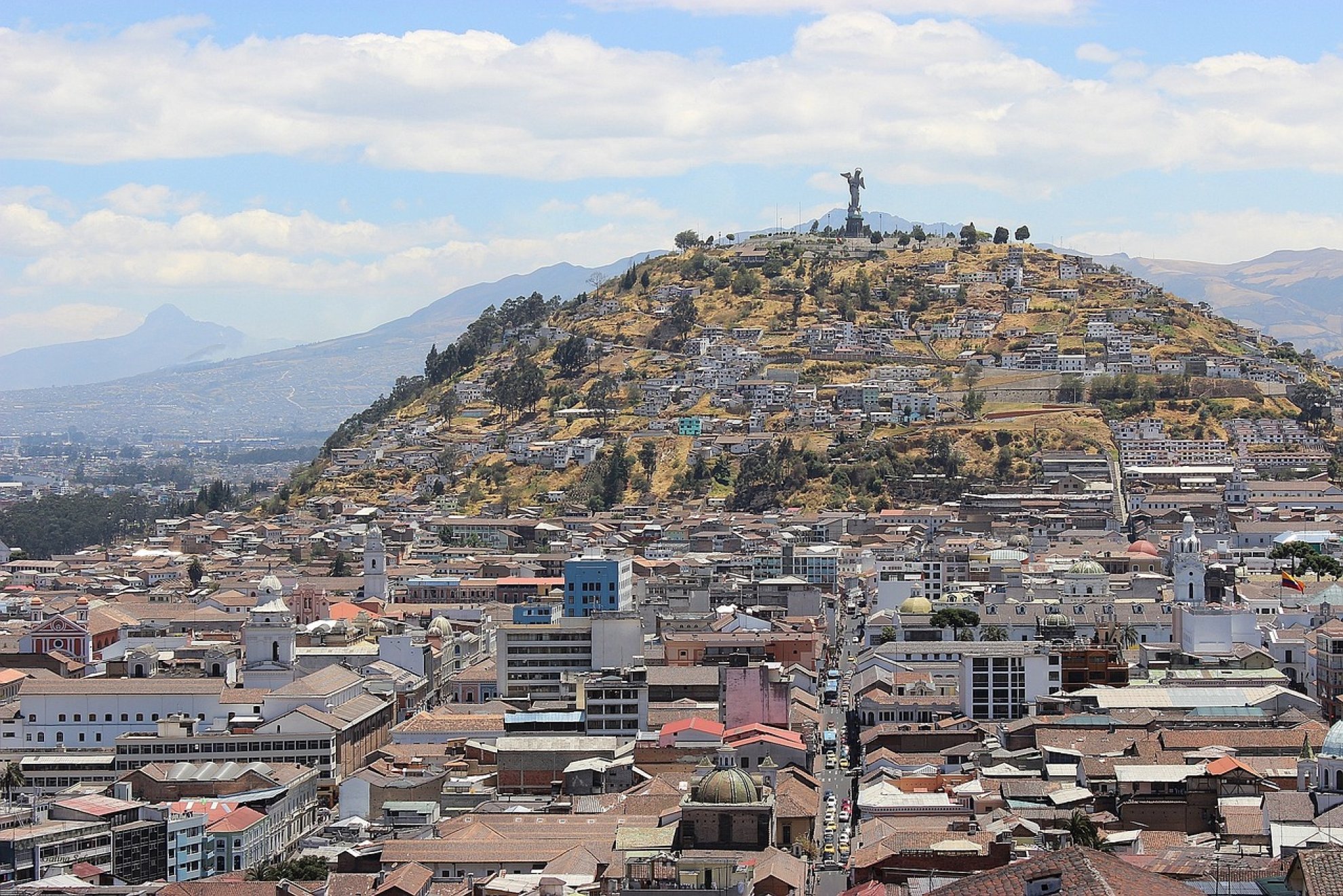
The Panecillo hill is the most important natural lookout of Quito. The elevation is located in the center of the city and this privileged location has become the most visited site of the Capital of Ecuador, because from its summit you can appreciate the urban structure of the city, both its historic center as the North and South ends. The Panecillo, called that way by the Spaniards since the time of the conquest because its shape resembles a bread, has on it a monumental sculpture of 45 meters high of the "Virgen de Quito", a creation of the Spanish artist Agustín de la Herrán Matorral, inaugurated in 1975, the world's largest artistic work made in aluminum. Herrán was inspired to make it in Bernardo de Legarda’s virgin, a sculpture of 30 cm, one of the most representative works of the Quito School. The elevation reaches 3.000 meters in height and in pre-Columbian times it was called Shunguloma or Yavirac. It’s been the subject of oil paintings and paintings by the most prominent Ecuadorian artists; El Panecillo during the time of independence was a Spanish fortress that fell on to the realistic and pro-independence forces, what today is known as the "Olla del Panecillo" was nothing more than the tank which was used to provide water to the fortress. As a tourist attraction, it is possible to visit the Museum of the Virgin or climb to the viewpoint that is located at the foot of the giant statue and have a view of Quito in 360 degrees, or see the Spanish tank. Around it there are restaurants, coffee shops, a crafts fair and a recreation area for kids.
Region
sierra
Province
Pichincha
Discover Quito, a charming city in the province of Pichincha, in the sierra region of Ecuador. A destination for visitors who want to explore the cultural and natural richness of Ecuador.
Browse the tourism services available all over Ecuador.
Find the ideal city for your next trip and discover everything about it.
Find the main tourist attractions in the main cities of Ecuador.