

Tour Operators

Tourist attractions in Ecuador
 BuenTrip Travel APP
Address:
Calles Nicanor Merchán y Héroes de VerdelomaTourism businesses within 30 km.
Places to visit within 30 km.
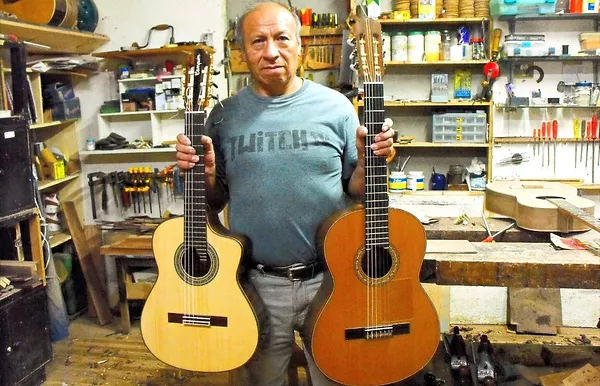
A prestigious brand of musical instruments is Uyaguari-Quezada. It has the support of the experience and professionalism of a family of luthiers, which for 4 generations has been dedicated to the construction mainly of the classic guitar. The ancestor of the Uyaguari family comes from the parish of San Bartolomé, "the cradle of guitars", in the canton of Sígsig. The artisan workshop is located in their house, Arquímedes street, Bellavista neighborhood, Cuenca. There, Luis Enrique and Pablo Andrés work together, making beautiful guitars. Pablo is the fourth generation of a family dedicated to the construction of stringed instruments. His father Luis, a craftsman since he was 13 years old, is the third of eight children of Julio Uyaguari, a native of the Sigsillano neighborhood. The "dynasty" would have started with Isidoro Uyaguari, Luis' grandfather. An anecdote tells that one day Isidoro disassembled a guitar to understand how it worked. That moment was the beginning of the family tradition. Art, passion, professionalism, tireless dedication, identity, creativity. These are the opinions of those who have visited the Uyaguari-Quezada workshop, describing their instruments as "authentic wooden jewels", delicate, subtle, moving. Although the Uyaguari specialty is classical guitars, they also make charangos, tiples, bandolas, bandolines. In other words, they are authentic luthiers in the original sense of the word. They use the most noble raw materials: capuli, cypress, teak and walnut. The sound of a guitar is defined by the soundboard. The two craftsmen dedicate more time to this piece, since the perfection of the instrument depends on it. Another skill that only gives the knowledge of the trade is the sensitivity through touch, to judge if a guitar is worth or not. Father and son are music lovers, the result of their work. They love Ecuadorian music, Cuban trova, the new Latin American song and rock. A luthier is a person who builds, adjusts or repairs stringed instruments such as guitars, cuatros or lutes. Today this name is extended to any artisan who repairs musical instruments in general, including wind and percussion instruments. A word of French and Arabic origin, meaning "wood".
0.35 Km.

The Municipal Economuseum "Casa del Sombrero" has four permanent exhibition rooms where visitors can appreciate the art of weaving the toquilla straw hat through videos, photographic representations, objects and materials used over time for this artisan work , practiced since pre-Columbian times. It has two exhibition rooms and sales of hats and articles made of toquilla straw.
0.68 Km.

A walk through the workshops and museums of the toquilla straw hat, curiously worldwide known as "Panama Hat", will make you discover that in fact it is original from and elaborated in Ecuador. One of the regions where it is woven is in the Ecuadorian Southern Andes, in the provinces of Azuay and Cañar. On December the 5th, 2012 UNESCO declared the traditional knitting of the toquilla straw hat as Intangible World Heritage. In order to recover the historical memory of this handicraft the Municipal Museum-Workshop “Casa del Sombrero” (House of the Hat) was inaugurated in 2014, in the city of Cuenca. It is located is in an old and emblematic house that functioned as a factory of hats. The initiative is public and free to enter. The elaboration of the hat was the economic foundation of the Ecuadorian population, especially in the south of the country, during the 20th century. Private initiatives also contribute to keep spaces where the story of the Toquilla straw hat is told. The first is the “Hat Museum” of the Paredes Roldán family (Calle Larga and Padre Aguirre, Historic Center, Cuenca, Ecuador). The factory continues operating on the site and the visitor can buy a custom-made hat. The second space is the Museum “La Magia del Sombrero” of the Homero Ortega company (Avenida Gil Ramirez Davalos 3-86, behind the Land Terminal, Cuenca, Ecuador). In 1830 the hats were commercialized in Panama. The Ecuadorian hat gained popularity because of being: resistant, light weighted, foldable for storage, combinable with light summer clothing and because of allowing sweat to evaporate. When the Panama Canal was constructed the workers used it and in 1903 a photograph of the President of the United States, Teddy Roosevelt, wearing this hat during a visit to the canal was widely publicized, which gave rise to the name of “Panama hat”. All this history and industry is based on the work of thousands of artisans and weavers who live in the small towns near Cuenca, such as Chordeleg, Gualaceo, Sígsig, Azogues and Biblián. The hat is also known as the “Jipijapa hat” or “Montecristi hat”, towns at the Ecuadorian Pacific coast that were the original centers of its elaboration.
0.70 Km.

Gran Colombia Street is the center of a dynamic commercial, artisan and cultural activity in the city of Cuenca. Known as the "Jewelry Street", it is also home to a museum dedicated to the work of the goldsmiths In a few blocks, you can find shops selling ceramics, clothing, embroidery, leather goods, and crafts in general. The jewel in the crown are the enterprises dedicated to the design, elaboration and commercialization of jewelry. In just two blocks and in a few minutes, it is possible to visit at least 10 jewelry stores with objects of the highest quality made by Cuenca craftsmen. And in the surroundings there are other 10 additional points of sale. To get an overview of this artisan work, one option is to visit the Museo de la Joyería Cuencana. It has a section that recognizes the trajectory of outstanding jewelers of the city. Another section exhibits tools and techniques used by the goldsmiths. In the workshop you can appreciate the process of elaboration of the jewels. The circuit is completed with the exhibition and sale of finished products. The city's jewelers are organized in an Association, which brings together about 50 artisans. In Azuay and Cuenca, the history of jewelry making goes back thousands of years. It is a heritage of the Cañari culture. In the pre-Inca period, the notions of art were established. The Cañari tradition was fused with the knowledge of the precious metals of the Incas. Later, during three centuries, the ancestral practices were mixed with what the Spaniards knew and their methods of extraction and production. The "Calle de las Joyerías" is currently the best showcase to observe the progress and development of this Cuenca craft. Foreign techniques have allowed the industrialization of the processes. The small artisan workshops have adapted to this change. The Great Colombia, named after the ephemeral unit created by Simon Bolivar, must be walked slowly. The objective: to pay attention to details. The architecture of their houses. The options open in their shops. Today it is the backbone of the Cuenca Tramway.
1.00 Km.

The church and square of San Sebastian constitute the western limit of the Historical Center of Cuenca (World Cultural Heritage Site by UNESCO). They are the main points of the historic neighborhood of the same name, in the urban parish of San Sebastian. The San Sebastian neighborhood is traditionally full of popular trades: pottery, tailoring, carpentry, tile-making, buttonhole making, painting. Tourism has a remarkable development with hotels, restaurants and cafeterias installed in heritage houses. The charm of its church, the park and an intense cultural life due to the presence of the Museum of Modern Art are the main attractions. There are craft workshops such as the embossing workshop of the master Carlos Bustos, several craft shops and bakeries. Recently, in a corner of the park, there is a restaurant owned by a Cuenca-Belgian couple that offers beer produced in the town. Every year, on December 24th, the "Pase del Nino Viajero" (The Traveler Baby Jesus), a traditional parade celebrating the birth of Jesus, starts from San Sebastian. The church, on the outside, has a single tower that dominates the facade. This is an unusual feature in religious architecture. Its main door is made of carved wood, with reliefs of the Bible's testaments. A large dome also stands out in the structure of the church. The interior of the Catholic temple is divided into three naves, separated by wooden columns. The space is quite sober, without as much detail or decoration as in other similar buildings in the city of Cuenca. On the corner of a small square in front of the temple's facade, at the intersection of Calle Bolívar and Calle Coronel Tálbot, stands the Cross of San Sebastián. Formerly this cross was the mark of the end of the city and the departure point towards the west. There are news of the church and its corresponding sector since the first years of Cuenca's foundation. It was a hermitage or small church of Fabián and Sebastián, saints and martyrs. As the centuries passed, the name of Fabián was abandoned, leaving San Sebastián as a traditional "Indian parish". Racial and social separation established by the Spanish colonizers to name a place that concentrated humble but necessary trades for daily life. The San Sebastian park is located next to the church. It has an ornamental pool and an interesting variety of trees and plants. The park is ideal for short walks, to rest and breathe fresh air. In its centre is the bust of the poet Miguel Moreno. In front of the park, on the opposite side of the church, is the Museum of Modern Art. Two historical events took place in San Sebastian Park. The first was the murder of the doctor Juan Seniergues, a member of the French Geodesic Mission (a scientific mission to measure Earth’s circumference), in 1739, during a bullfight. The second event are the first football matches in Cuenca, which were played there at the beginning of the 20th century. The geometric layout of the square, which has Renaissance influence with parterre gardens in the Versailles style, is attributed to Octavio Cordero Palacios.
1.00 Km.

The museum displays materials and tools for the jewelry work. It is located in a cultural heritage property. The craftsman in charge performs live demonstrations of the process as well as allows the visitor to interact and be part of the making process
1.03 Km.
Browse the tourism services available all over Ecuador.
Find the ideal city for your next trip and discover everything about it.
Find the main tourist attractions in the main cities of Ecuador.