

Tour Operators

Tourist attractions in Ecuador
 BuenTrip Travel APP
Address:
Avenida Batalla de Pichincha y JambelíTourism businesses within 30 km.
Places to visit within 30 km.

Of gothic style, place of devotion and visit of thousands of believers from different parts of the country. It was restructured and raised in magnificent work. Its construction began in 1893. The chapel was built on a rock, on August 26, 1894, people from all over Ecuador come to this place, and it was also restructured and built in a magnificent work, using carved stone. The adoration of the Blessed Virgin of El Rocio, is one of the most important manifestations of the Christian faith, it has a tower and naves supported by 49 granite columns, among which more than 36 arches alternate and beautiful wrought iron and glass chandeliers hang. the light highlights the rocky walls of the hill. It has a unique architectural and cultural beauty, it was declared "Cultural Heritage of Ecuador" in 2007. It is also a natural viewpoint from which the rich landscape of the area can be observed. Location It is located on the steep hill of Zhalao, located east of the city of Biblián, in the province of Cañar. The Sanctuary of the Virgen del Rocío has different activities that are: Walks, hiking, photographs and videos, knowledge of the history of the place, visits to temples, cemeteries The highlights of Sanctuary of the Virgen del Rocío The top of Zhalao: It offers an impressive panoramic view of the cities of Biblián and Azogues. Architecture: The Sanctuary of the Virgen del Rocío was carved out of rocks leaving areas of bare rock inside the church. This sanctuary is supported by 49 granite columns between which arches alternate and hang beautiful wrought iron and glass chandeliers.
0.81 Km.

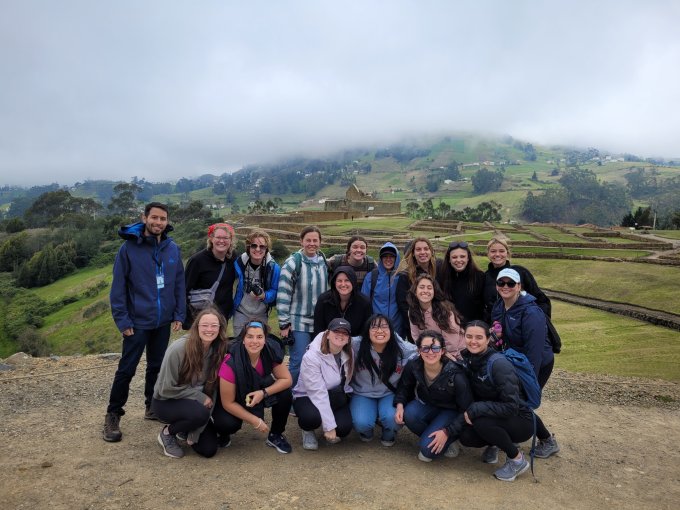
Knowing this complex is a magical experience that will take you on a trip to the past, the structures of Cojitambo are solidly built based on edged blocks of andesite rock, placed one on top of the other forming natural rows, joined with black earth mortar and filled with masonry. All these sets, which are complemented by other evidence of a military and religious nature, are articulated with the Inca trail that passes through the base of the hill, and that in aboriginal times communicated the ancient Tomebamba with the Cañari lordship of Peleusí. The archaeological complex is quite extensive and has constructions with a level of complexity; Due to this, it has been divided into 3 architectural ensembles, based on their spatial distribution and some features that differentiate the sectors from each other: Set I: Which is made up of a large square with a central usnu in the shape of a "U" with round corners open to the east. The walls that make it up are 1.80 meters high by 1.53 meters thick, inside there is a circular water well lined with stone that measures 2.20 meters high by 1.80 meters in diameter. Set II: Which is made up of a large residential terrace, with a retaining wall, and two platforms with retaining walls, and two platforms with retaining walls in the lower part. Complex III: Which is made up of a rectangular structure with two rooms, 6 platforms with retaining walls, 5 housing bases, 4 stairways and a space delimited by a curved wall that covers an area of approximately 682.5 square meters, to the southeast of Square. All these sets of structures and stone foundations cover an area of approximately 25 hectares, on the west side of the hill. In these sets there are: Next to the access road there are three rooms for lodging and administrative activities. A set of several housing and farming terraces that follow each other in a staggered manner from the top to the base of the hill, on the north and west sides. Location Cojitambo Archaeological Complex It is located 11 kilometers west of the city of Azogues, on the western foothills of the eponymous hill, in the Cojitambo parish.
5.03 Km.

The Cojitambo hill is of a multiform type according to the angle from which it is seen: From the north: looks like a sleeping lion From Azogues: looks like a greyhound sitting on its hind legs From the south: it appears gallant and imposing, in a pyramidal shape, like a peak that hurts the blue part of the sky. Precisely because of its morphology, the Cojitambo hill is a perfect natural viewpoint, as it offers a 360-degree panoramic view and at a distance that exceeds 30 kilometers; for which from its top you can appreciate beautiful and varied landscapes. For these reasons, the Cojitambo hill is perfect for photography lovers, as it offers several perfect places to photograph, which is why it attracts professionals and amateurs in this art. Location: The Cojitambo hill is located 11 km west of the City of Azogues, in the Cojitambo parish, of the Azogues Canton. Activities that can be performed: Get to know the Cojitambo Archaeological Complex Knowledge of Cañari - Inca history. Lookout. Contact with the nature. Hiking and camping. The area is free camping. Rappelling and climbing practice. Recreation for children and adults. Photo shooting. To take into account: A guide is not required, but if you are a novice you should go with one for safety. There are hostels in the surrounding areas from 5 to 10 dollars a night.
5.17 Km.

The Museum of the Gastronomy of Cuenca is located in the north exit of the city of Cuenca, in a rural zone but with an accelerated urban development, known as Chaullabamba, aboriginal word that translated means "plain of the fishes". In the museum, the history of the region's cuisine is told, and traditional and typical Andean dishes, fused with international cuisine, can also be eaten. It was founded in April 2019 in the country house of the Urgilés-Cueva family, owners and administrators of the enterprise. The culinary knowledge within the interactive museum, its activity and history are intimately related to tourism and being aware of this aspect the couple Miguel Urgilés and Karen Cueva, who is also a chef, decided to open the Museum. Whoever decides to live this experience will find 2,000 kitchen utensils in the rooms of the house, which were once used by families in the past. The welcome ritual is with a glass of chicha de jora (a drink made of corn and inherited from the Incas) or with the "grandmother's drink" or aromatic water (an infusion made with herbs of the region). A tour of the Museum takes an estimated three hours, which includes the projection of a video and a lot of information about food production, the use of agricultural tools, the sowing-harvesting process and cooking. The collection is organized to celebrate the fusion of the Cañari, Inca and Spanish cultures, which give identity to the current mestizo culture. Visitors have direct contact with each piece in the exhibition, they can touch them, feel them, experience how they were used or what they were used for. A very special room is the "Sala del Uchu" or chili pepper in Kichwa, a native American plant with more than 40 species. The development of the Andean culture is related to the chili. Here the visitor can grind it or "chancar". Another experience is to break "toctes", local fruits similar to nuts.
15.82 Km.

Cerro Narrío is one of the most important sites for archaeological research in the south of the country. Several renowned archaeologists, both domestic and foreign, have visited and studied the site. Due to the construction style of the architectural elements and the great variety of cultural materials found in systematic archaeological excavations, it has been determined that the archaeological site of Cerro Narrío was occupied by aboriginal groups, from 2500 BC. C. until 1532 AD. c. This hill was a place of settlement for societies that came from different parts of America 5,000 years ago. C. so it is not ruled out that this culture is one of the oldest in the country. The highlights of Cerro Narrío Ruins Burials: In Narrío the southern and western flanks were used as burial places and many hundreds of graves were found in them. A late grave is made up of a pit 1.50 m deep and 60 to 80 cm wide, within which the body is placed in a flexed position, apparently sitting. Archaeological and Ethnographic Museum of Guantug: This ancestral cultural space, located in the recreation park, Guantug, in the city of Cañar, highlights art, music, customs, dance, agriculture, commerce and fabrics. of the Cañari people. The museum is made up of 6 collections of archaeological pieces, ceramics, stone, shell, bone and metals such as gold and silver. Location The archaeological site of Cerro Narrío is located on the left bank of the Shan-Shan ravine, half a kilometer northwest of the city of Cañar.
18.38 Km.

In this museum there are in its interior, in three rooms, samples of our aboriginal cultures such as the Cañari and Inca, represented in elements of ceramics, shell, gold and bone. In an architectural environment, elliptical in shape, imaginarily directed towards the cardinal points; in such a way that from the central part, said cosmically, it will be possible to visualize the location of the geographically cultural community components. Each one presents details, colors, shapes, textures and sizes that mark the difference of the periods of the Cañari Culture, which are three: Narrío, Tacalshapa and Cashaloma.In addition, in the room, visitors can see a last period, the Inca and the fusion with the colonial that, although they are foreign cultures, are part of the history of the region.Even in the place several events of socio-cultural animation have been developed. Location They are located in the city of Cañar in the Guantug recreational park, of special singularity, in its designs, planning and projection. The museum began its activities in 1982 and was inaugurated in August 1992
18.81 Km.
Browse the tourism services available all over Ecuador.
Find the ideal city for your next trip and discover everything about it.
Find the main tourist attractions in the main cities of Ecuador.