


Ecuador travel
Tourist attractions in Ecuador
Explore the tourist attractions of Ecuador.

Basilica of the Queen of the Rosary of Baños de Agua Santa
The church of the Virgen de las Agua Santa is located in the center of the city of Baños. Inside you can see a collection of murals that describe local miracles, attributed to the Virgin, patron saint of the city. The Basilica is of architectural infrastructure, this artistic work defied time and history. There are many devotees who have delivered plaques of gratitude to the miracles paid to the Virgin of Holy Water Location Address: December 16 and November 12 Hours of operation:Daily from 09:00 to 19:00 Entry cost: Free Mass Celebration Hours Daily 07:00; 11:00; 16:00; 18:00 Saturdays: 07:00; 09:00; 11:00; 16:00; 18:00 Sundays: 06:00; 08:00; 09:00; 10:00; 11:00; 12:00; 14:00; 16:00; 19:00 How to get there Information 45 minutes from the city of Ambato, is the tourist city of Baños, which takes its name from the use made of the ferruginous thermal waters that come from the Tungurahua volcano, also called the “Gateway to the East” because it is there that the Ecuadorian Amazon region, city surrounded by beautiful mountains, waterfalls and the Tungurahua volcano. From the Basilica of Agua Santa Information The Basilica or Sanctuary of the Virgin of Agua Santa, without a doubt for all Catholics, is the most important architectural infrastructure in the canton. This artistic work defied time and history since it was in 1944 when its construction was finally completed. The church was built in the center of the city of Baños, surrounded by beautiful mountains, waterfalls and the Tungurahua volcano. Its construction began on February 11, 1904 by Fr. Thomas Halflants, parish priest of Baños, and was completed in its entirety in 1944 by Fray Sebastián Acosta. It is divided into 3 naves, it is semi-gothic in style, its shape is rectangular with large columns and pointed arches. All the decoration and the canvases that adorn the walls were worked by the Imbabureño Fray Enrique Mideros. Inside the Basilica you can see a collection of murals that describe local miracles, attributed to the Virgin of Holy Water. When the small town had just been founded by the Dominican fathers, a humble shack served as a church. One night the sacristan saw that the image of the Virgin Mary left the hut accompanied by two angels coming to rest at the foot of the stream of water. The father and the inhabitants of the city of Baños met and asked the Virgin to manifest her will. The following night, the Virgin appeared before the priest and declared that her wish was for a temple to be built for her at the foot of the stream, assuring that the lady of heaven would cure the sick who bathe in those waters by having a lot of faith and they would be free from their diseases. In addition to being a shrine, this church has served as a refuge when the Tungurahua volcano erupted on multiple occasions and the surprising thing is that the people who have remained here have escaped unharmed, which is why the image remains inside this sanctuary. Every year in the month of October the festival is celebrated in honor of the Virgen de Agua Santa. It is visited by hundreds of national and foreign tourists who come in search of spiritual peace, a favor from the Virgin or simply for devotion. October 07, Festivities Virgin of Baños de Agua Santa This dedication arose in the city of Baños, Ecuador, when the small town had just been founded around the year 1570 when the Dominican missionaries toured the region evangelizing the centers of Ambato, Pelileo, Patate and Canelos, a humble hut served as a church. One night the sacristan saw that the image of the Virgin Mary left the hut accompanied by two angels coming to rest at the foot of the stream of water. The father and the inhabitants of the city of Baños met and asked the Virgin to manifest her will.
135.91 Km.

Kamak Maki Community Ecotourism Center
The Kamak Maki Community Ecotourism Center is a community project with the goal of preserving the ancestral knowledge of the region and educating people about the Kichwa culture and other cultures of the Ecuadorian Amazon. Tourists are offered tours from 1 hour to 4 days. The Amazon has many options for unforgettable experiences, you will share with the Kichwa people of the community. Museum Tours Tour of the museum, medicinal plants, and animals (one hour) This basic tour is normally done from Misahualli with a canoe ride, but it can also be done directly from the Tena-Ahuano road. The tourist or group receives a native guide to take an interactive tour of the ethnocultural museum, medicinal plants, and animals. It takes between 45 minutes and an hour, and ends with the opportunity to bring handicrafts as a souvenir of the site or natural medicine (such as dragon's blood, guayusa or medicine for diabetes or gastritis). It is an opportunity to learn about the culture through the museum and the plants, see the animals in their own habitat and get to know the beautiful community next to the Napo River. Location: The project is located in the community of Chichicorumi, about 45 minutes from the city of Tena, and 15 minutes by canoe from Misahuallí. Business hours From Monday to Sunday from 06:00 - 18:00 Prices Lodging per person $10.00 Entrance to the national pax river $ 2.00 Entrance to the foreign river $ 4.00 Entrance to the river children $2.00
136.16 Km.

Ulba waterfalls
In Baños de Agua Santa, just 5 minutes away on the Baños - Puyo road, you will find a sign at the entrance to the waterfalls sector. The cost of access is USD 0.50 per person , only adults, from that place are 500 meters to where you can park your vehicle or go walking through the place. After parking your vehicle or arriving at this place, you will find a bridge made with wooden beams through which you must cross, here you receive a very particular character, where you must cancel an additional 0.50USD , here this character will explain the time to go to one or another waterfall, after crossing the bridge you must choose your initial rtua. Entering the left path you will have to walk around 6 minutes to reach an impressive waterfall, here if you are lucky you can see national and foreign tourists doing Canyoning, an extreme sport that is characterized by descending canyons or waterfalls. Entering the path on the right, after walking around 12 minutes you will find the Ulba waterfall that has a fall of about 40 meters high. You can also cool off in its cold waters that are perfect for a sunny day and after the walk. Important Recommendations Bring sunscreen Bring bottles of water, additional snacks (there are no places to buy anything in the place) Wear comfortable shoes for the walk. Do not litter on the trail. Do not light fires that can cause fires. Bring fractional or loose currency to cancel the entry value. Photographic camera. We hope you enjoy this adventure, if you want you can enter the Tourist Guide of Baños de Agua Santa and book accommodation , activities and tours in Baños de Agua Santa, the best restaurants and review all the information about Baños de Agua Santa.
136.25 Km.

Route of the Waterfalls between Baños and Puyo
This is perhaps the greatest route of nature tourism in Ecuador. Easy access and magnificent landscapes. The Waterfall Route. For 60 km, the Baños-Puyo road runs along the left bank of the Pastaza River. Before the eyes of the visitor the powerful waterfalls with their attractive names parade one after the other. Tourist services of all kinds are in full swing all along the way. The tarabitas to cross to the other side of the Pastaza are very popular. The best known waterfall is Agoyán. 60 meters high with a powerful energy. At a bend in the road there is a viewpoint. Each waterfall is a great experience. Adventure activities abound: bungee jumping, canyoning, hiking, cycling, jumping. There are 60 waterfalls with dozens of entertainment options. In a preliminary list they are: - Inés María; at the entrance to Baños. - Cabellera de la Virgen; Cerro Bellavista. She can be seen from the center of Banos. - Ulba; first of a series of waterfalls on the Ulba River. At 4 km. from Banos. - Chamana; 2 km from the Chamana sector. 7 waterfalls. El Silencio waterfall stands out. Place for hiking, swimming and canyoning. - Bascún; 500 m from Baños. - Manto de la Novia; to reach the waterfall there is a 100 m suspension bridge over the Pastaza. Activities: swimming, landscape photography. 11 km from Baños. - San Jorge; ideal for canyoning. It has trails and natural viewpoints, canyons, waterfalls, and diverse ecosystems. At 12 km from Baños. - El Fantasma and El Placer are 3 hours away from the town of El Placer. At 14 km from Baños. Activities: hiking, horseback riding, camping, flora and bird watching. - San Pedro; 14 km from Baños. A triple waterfall, which stands out among the green vegetation. It can be reached by the longest tarabita in the country (400 m) or by walking along a path that joins San Pedro and Manto de la Novia. - Duende; 18 km from Baños, Río Verde parish. It is formed by rocks of volcanic origin. - Río Verde or Pailón del Diablo. It has steps carved into the rock below the waterfall. At 18 km from Baños. - 7 waterfalls of Machay; 25 km from Baños: Manto del Ángel, Las Orquídeas, San Agustín, Refugio de los loros, San Miguel, Peñón del Tucán, Manantial el Dorado. - San Francisco and Refugio del Gallo de la Peña; 28 km from Baños. Birdwatching, orchids and cloud forest. - 4 waterfalls of Cashaurco; 4 km from Rio Negro: Brisa Hermosa, Cashaurco, El Tambo and Algodón.
137.03 Km.

Manto de La Novia Waterfall
Manto de La Novia Waterfall The waters of the Chinchín River form the Manto de la Novia Waterfall located in Baños de Agua Santa , Provincia de Tungurahua , Ecuador , this name was adopted to this waterfall because the waters that fall from the waterfall have such whiteness that they resemble the bride's mantle . How to get to Manto de la Novia Waterfall? From the city of Baños de Agua Santa is at a distance of 11 kilometers, you can have several ways to access this wonderful place: by the footpath and suspension bridge and by means of a tarabita. If you prefer to admire this waterfall in a much closer way, you can go down to look at it by a path that is in sight and then cross a suspension bridge over 100 m long that is on the Pastaza River, until you reach the foot of it. wonderful waterfall where you can bathe , take pictures and admire the wonderful landscape . It is advisable to wear comfortable shoes for walking, the trail is quite steep that has some small stones in its rustic stands and to lower it you can do it in a time of 10 minutes, but to increase the time it can even double according to your physical condition, For this reason it is important to bring water or hydrating drinks , as well as sunglasses and sunscreen on sunny days. At the access to Manto de la Novia Waterfall there is a kind of control where you must pay a value of 1.00 USD for accessing the waterfall, also in this place there is a shop where you can buy some candy or hot or cold drinks . The waters of the waterfall have a temperature of 10 degrees Celsius , if you want you can bathe in them, the same ones that are free of contamination. The Manto de la Novia waterfall is approximately 40 meters high with only one fall. The landscape around the waterfall shows how nature has developed to make way for the life of wild plants and animals that visitors can see, the crystalline waters that form the waterfall enhance the landscape. Tarabita Manto de la Novia The tarabita takes tourists to the other side of the Pastaza River and witnessing the beautiful natural formation called Manto de la Novia, it costs USD 2.00 per person. Manto de la Novia Banos Ecuador The Manto de la Novia waterfall is characterized by an exuberant sub-tropical vegetation flora and fauna. Flora Among vegetation you can find several plants such as pumamaqui, alder, Chuquiragua, Almohadilla, Achupalla, Pega Pega, Alder, Bromeliads, myrtle, olive, laurel, cedar, pantza, licopodia, palms palm, royal palm, copales, mahogany, achupallas , chuquiraguas, guayacán, gentians, chontaduro, camphor, neurolepis, tagua, pajonal and a great variety of mosses, epiphytes, ferns, bromeliads and orchids. Wildlife The Cascade the Mantle of the Bride has a beautiful landscape, and from there the observation of a large number of birds of different colors, sizes and species that settle on the rocks is made. Additionally the fauna of the place allows us to observe mammals such as the monkey machin, spectacled bear, tapir, puma, jaguar, guanta, porcupine, and anteater; bird species such as duck, Andean gull, duck, condor, congos, royal pilco or chick, curiquingue and hummingbirds, bunga and sword beak.
137.23 Km.
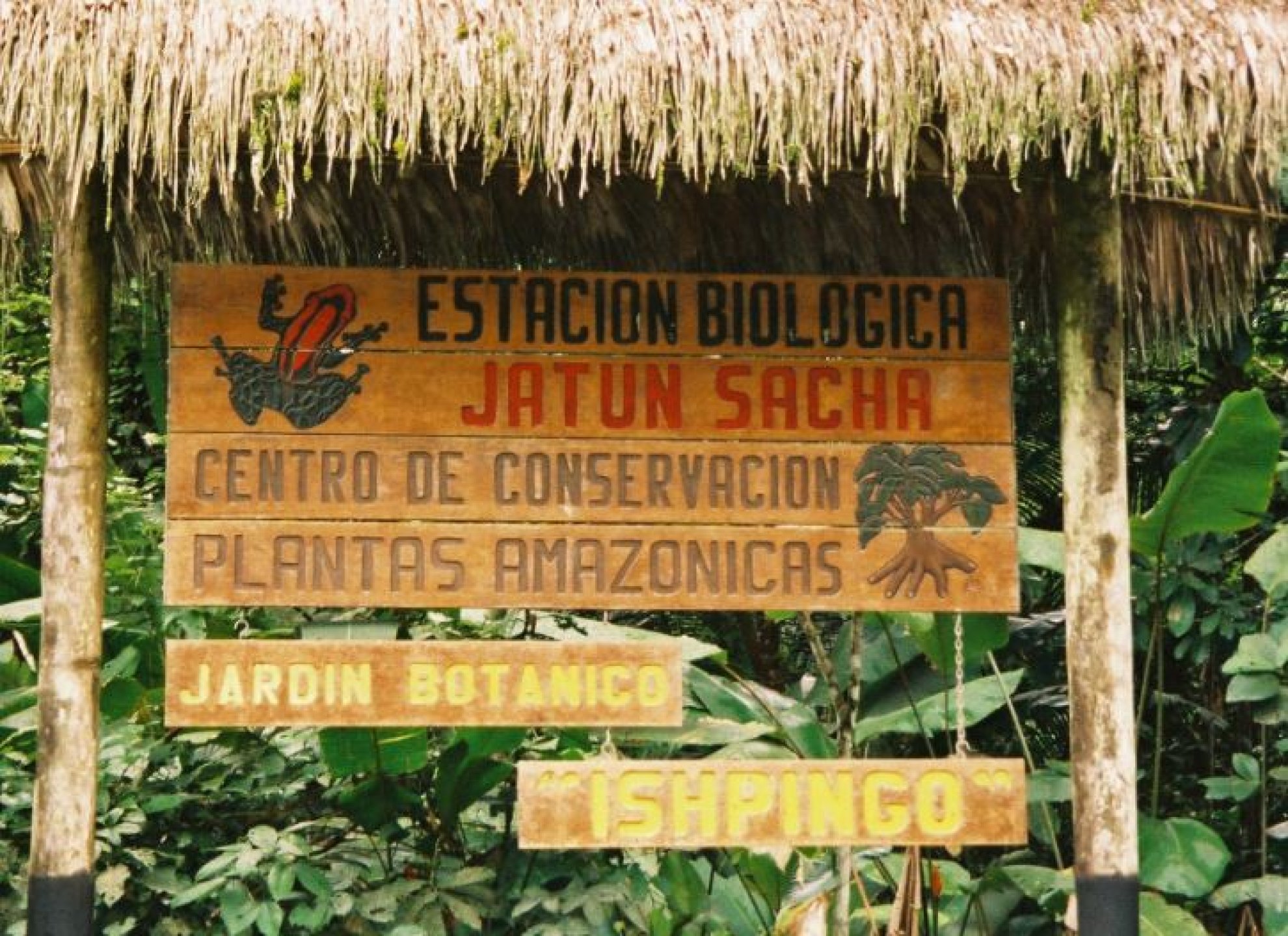
Jatun Sacha Biological Station
Enjoy Jatun Sacha where there is a path that discovers the forest and its species. The treetops form a closed dome through which only a few rays of sunlight filter through. Jatun Sacha means "Big Jungle" in Quichua, the native language of the communities surrounding the biological station. It is a private non-profit organization whose mission is to promote the conservation of the forest, aquatic and paramo ecosystems of Ecuador. Its main objective is to promote biological research, environmental education, the conservation of the tropical forest and the management of biological resources. Highlights of Khatun Sacha Conservation Center: In 1993 along the Ishpingo Botanical Garden, in collaboration with the Missouri Botanical Garden to support the development of research, reforestation and community development projects. Telecenters: Through the Operations Center, for the Internet connection of schools in the locations where the Telecenters Project is executed. Gran Sumaco National Park: Development of support activities in the Gran Sumaco National Park. Farms: Maintenance of comprehensive farms for the production of fish, native fauna, organic fruits and vegetables. Location It is located south of the upper Napo River, 8 km east of Puerto Misahuallí or 28 km from the city of Tena.
138.01 Km.

Pailon del Diablo (Devil's Pot) Waterfall
The Devil’s Pot (Pailón del Diablo), a giant waterfall and main tourist attraction of Río Verde parish, is located next to the road that goes into the Amazon rainforest, towards city of Puyo, 20 minutes from the city of Baños de Ambato, in Ecuador. A rocky mass at the end of the waterfall, in the form of a large dish or frying pan, gives rise to its name, which is complemented by the face of the devil that is observed in the rock when crossing a suspension bridge located on the site of the waterfall. The Devil’s Pot is formed by three waterfalls that fall with force from a height of 100 meters offering to the visitor a beautiful and impressive spectacle, which ends in a surprising whirlpool. More than 18 waterfalls can be seen on the Baños-Puyo road, but the Devil’s Pot is the most beautiful of all, because of its grandiosity and the beauty of its turquoise water, with a temperature of 23 degrees celsius. To observe the waterfall closer you must descend along a well-marked path, in the midst of semi-jungle vegetation surrounded with a great variety of orchids, at the end you arrive to a suspension bridge and to a viewpoint at the edge of the pot. Once there, the visitor is wrapped in a thick cloud of raindrops as the result of humidity. The water stream continues descending through a rocky mass and the view get lost in a thick vegetation cover. The Devil’s Pot’s (Pailón del Diablo) surroundings are ideal for the observation of flora and fauna, like the Andean cock-of-the-rock, tapirs and butterflies. The entire route of the Baños-Puyo road is full of things to observe, such as the Agoyán hydroelectric dam, two tunnels, and natural landscapes.
138.03 Km.

End of the World Tree House and Swing
What should you know before visiting the Tree House and the Swing at the End of the World? This site is located at an altitude of 2,660 meters above sea level and is located in the Runtún hamlet. How to get to the Tree House and the End of the World Swing From the city of Baños Ecuador there are tours that go to the tree house every day and have the schedules of 10:00, 12:00 and 16:00, the cost ranges between $6 and $10. If you choose the bus, the schedules are the following 05:45/11:00/14:00/16:00 or you can do it by renting motorcycles or quads that range from 15 to 20 usd. Or you can get there by own car. Entry Costs The entrance to the complex has a cost of 1 dollar, and it is open from 07:00 to 19:00, the gastronomic offer has an average price of 3 dollars. Getting to Casa del Arbol from Baños Ecuador takes an estimated time of 45 minutes. What to bring Tree House Baños Sunscreen Glasses Warm clothing Photographic camera Baños de Agua Santa has this wonderful place that is located on the slopes of the Tungurahua volcano in the Runtún area, thus having a seat in the front row for the show that it offers us, since it is an active volcano and you can see a mushroom of smoke from afar, although it is an incomparable view, this reminds us that we must always maintain our respect with mother earth, the rumblings that are heard from the volcano being a sample of how powerful it can be. They say that 14 years ago, when the people of Baños were returning to their homes after the evacuation that lasted a year, Mr. Carlos Sánchez, a native of Banes, made the decision to build a tree house, but he did it on the edge of the hill. When the work was finished, and the tree house was built, the word spread, and visitors from all over began to arrive, the fabulous view where you can appreciate the landscape attracts everyone's attention, in addition the tree house has a swing which serves as entertainment. The famous tree house is nothing more than an elevated wooden cabin near a precipice, as a curious fact that natural channel indicates to volcanologists where the lava would descend. When tourists visit this place, you can see the concern on their faces, but they are soon reassured as Don Carlos tells them that he has a shelter to protect himself in case the volcano throws up the incandescent rocks. When Tungurahua is quiet and quiet, as Carlitos comments, it is easier to serve the people who visit the place. 'Carlitos' as some call him has all the time in the world to better serve those who visit him. Where he tells them about his job as a lookout and giving talks about the events of the volcanic activity of Tungurahua. Those who meet in this place have the opportunity to admire the Tungurahua volcano in the first row, without missing any detail. The tree house tourism The best place to observe the Tungurahua Volcano is without a doubt the Tree House in Baños de Agua Santa, without a doubt one of the best tourist places in Ecuador. The tree house in Baños is one of the most visited tourist destinations, it has modifications made to preserve the safety of the visitor, it is a beautiful tourist attraction. In this place you can see the majesty of the Tungurahua volcano. In your travel adventures in Baños, you cannot pass up the opportunity to taste the delicious gastronomy of the place, without a doubt you should try the typical food of Baños de Agua Santa and pamper your palate. End of the world swing Admiring the Ecuadorian Andes from this place will be an experience that will envelop your senses and where you can enjoy the enchanting landscapes. additionally you can enjoy a picnic accompanied by your friends or family. If you are a nature lover, the landscapes in this place will surprise you, including the best view of the Tungurahua Volcano and the mountains that surround the city of Baños, Ecuador. Being the End of the World Swing a tourist attraction, you can also do other adventure activities such as canopy, or walks, or challenge your balance on the poles or simply to enjoy a tasty snack from the Ecuadorian Andes.
138.16 Km.

Tulcan cathedral
It is a wonderful architectural church that has magnificent images of artistic value. It has an altar carved in gold leaf. Its restoration culminated in the year 2000. The remodeling of the Cathedral adopted a modernist style. Its interior is in the Romantic style, with classical-style altars. The façade was set back with a stone plinth and a tower finish. It has a monumental portal, with three domed naves, three fronts and relevant samples such as the Virgen de las Lajas and La Dolorosa belonging to the Padre Bedón School, as well as oil paintings.It has an impressive Altar of the Lord of Good Hope with the carved executioner, in colonial style. Also, the image of the Virgen de la Visitación stands out, considered the protector of Tulcán, from earthquakes. Its decoration arouses the attention of visitors to this Cathedral, as the capitals have internal columns covered with grapes and acanthus leaves. Address The cathedral church of Tulcán is located a few steps from the Plaza de la Independencia. On Av. Sucre and Pichincha. Highlights of the Cathedral of Tulcán Architecture of the Cathedral of Tulcán: Tulcán Cathedral The Cathedral has an Altar of the Virgen del Carmen, in gold leaf and classic style. It has an impressive Altar of the Lord of Good Hope with the carved executioner, in colonial style. sculptures: The image of the Virgen de la Visitación stands out, considered the protector of Tulcán, from earthquakes. Among the plastic arts belonging to this temple, the Sculpture of the Sacred Heart of Jesus, La Inmaculada, San Pedro, San Judas Tadeo, San José, San Francisco with the children, Virgen del Tránsito, El Señor de la Columna, San Vicente Ferrer stand out. , Santa Teresita, San Cayetano, San Martín de Porres, Our Lady of Fatima and Santa Marinita de Jesús. Recommendations Take pictures without flash Help preserve the collections Do not enter food Do not enter with suitcases and large packages
138.80 Km.

Saint Francis of Assisi Catholic Church
It is composed of an interesting architecture, contains images of the Virgin, the shepherds draw attention to the craftsmanship in its finishes. It is located in the heart of the city, in it is the conventual center of the Community of Capuchin Fathers. The Church has an aesthetic influence on the modernist facade, straight with an octave, on two levels with a stone plinth, cornice finish and composite portal. It has a Latin cross with chapels in transept naves. Among the relevant samples, the Image of the Divine Shepherdess (Patron Saint of the Capuchins) stands out, of great cultural value and among the plastic arts, there are paintings such as the Virgen de la Dolorosa and that of Hermano Miguel, made by Falconí Dillon. The highlights of the San Francisco Church Architecture: Neoclassical in style, it was built from 1875 with the arrival of the Order of the Capuchin Fathers of Saint Francis of Assisi, who established the church based on plans by Father Luís de Beltrán of Central American origin. The facade is straight ochave, with exposed stone plinth, the facade finish is cornice, molding and ornamentation with band boxes and flat keys, the foundations are stone, the walls are brick and the roof is tile and wood. It has approximately 1200m2 of construction. How to get? From Tulcán, located in the center of the city, on Bolívar and García Moreno streets.
139.30 Km.

Isidro Ayora Park
It is one of the most modern parks in the City of Tulcán. With its green areas, pools, and it is also the preferred place for family walks, as well as a strategic site for fairs and different sporting and artistic events. Located in the central commercial part of the city. Here is the point of departure and arrival of public transport to and from Colombia. The lighting of the pools enhance the monument of the liberator, the same as it is an astonishment to the architectural style. The architect of this urban space was the architect Gato Sobral and the design can be seen from the sky. The peculiarity of the park is the position of the statue of Abdón Calderón on horseback, the entire sculpture is supported only on one of the animal's legs and is practically floating in the air. Inside the park there was a beautiful lagoon on which small boats took the citizens, years later they were changed for pools. In the center of the park there is also a sundial that marks the time, its original design is still preserved despite the remodeling that took place in these spaces for half a century.
139.55 Km.

José María Azael Municipal Cemetery
The green cypress sculptures created by José María Azael Franco Guerrero, for whom the park is named. They are replicas of characters from the pre-Columbian, Augustinian and Arab periods. The work occupies the left front part of the church cemetery and is called God's Altar, while the rear garden is called Parque de los Recuerdos. The cypresses grow strongly in the Tulcán Cemetery thanks to the calcareous soil of the place. From the tenth year of the tree's life they begin to shape them according to the wishes and imagination of the artist-gardener at each moment. There are 309 sculptures made of cypress distributed in the four hectares of garden area of the 8 hectares that the cemetery has in total. Along with the 309 topiary works, there are more than 12,400 niches among those of the columbariums, burial mounds and mausoleums. One of the curiosities of the Tulcán Cemetery is that the figures, according to their theme, divide the cemetery into two zones. The first with the flora and fauna is called "Park of memories" and the second with the rest of the forms is the "Altar of God" where we can see semicircular arches, monolithic figures, masks or vessels among other things. Style The cypress figures called sculpture in green, found in the cemetery have a Greek, Egyptian, Inca, Arabic style, and natural forms. Currently you can see figures referring to the fauna of the Galapagos Islands, idols and masks of the indigenous cultures of Ecuador, Gothic columns, arches, among many others. How to get? Located in Tulcán on Av. Cementerio and Cotopaxi, in the center of the city, a few meters from Parque Isidro Ayora. It is a work of art built in 1936, on cypress trees, it is a green sculpture with representation of the Egyptian, Roman, Ecuadorian, Inca cultures as well as representative animals of Ecuador. On May 28, 1984, the work was declared "Cultural Heritage of the State" by the Institute of Cultural Heritage of Ecuador. On August 23 of the same year, the National Directorate of Tourism declares it, together with its interior gardens, as a "Natural Site of National Tourist Interest"
139.74 Km.
We have 413 tourist attractions listed in Ecuador.