

Ecuador travel
Tourist attractions in Ecuador
Explore the tourist attractions of Ecuador.

awá bioanthropological reserve
It is inhabited by the Awá community, aborigines who maintain their cultural traditions within a semi-jungle vegetation with large forests and plains, a mountain rich in flora and fauna, ideal for bird watching, typical of the region.It has an extension of 120,000 hectares that are shared by the provinces of Carchi and Esmeraldas. In the surroundings there are portions of remnants of subtropical and tropical forest. It is presumed that in the areas of human occupation there are subsistence agricultural and livestock activities, as well as wood extraction and hunting to a lesser degree. The existence of 170 species is known, among which there are several threatened with extinction, which in turn are endemic. This reserve is suitable for those who enjoy ecological walks. How to get? From Tulcán: By private vehicle or public transport 125 km from Tulcán along the Maldonado - Tobar Donoso road, then continue about 6 hours on foot to the Awá village. recommendations Wear suitable clothing: wearing long-sleeved clothing will prevent you from being bitten by mosquitoes and insects. It is also important to wear special pants that dry quickly for expeditions. Avoid dehydration Don't get off the road Protect your electronic devices: The humidity of the jungle can seriously affect electronic devices, so it is convenient to store them in sealed bags. Backpack instead of suitcase
141.92 Km.

Customs house
Its construction began in 1933 and ended in 1936, with materials such as brick and stone in its structure, roof is made of bahareque and concrete, in the central part it is made of glass due to the new remodeling. Its style is eclectic with neoclassical influence, applied to traditional Ecuadorian architecture typical of the early twentieth century. It is surrounded by modern buildings, customs controls and immigration; Very close is the current Rumichaca International Bridge. The height is 10.7m, the facade is divided into three floors. The windows are semicircular arches, Ionic and Corinthian columns, topped with cornices and a triangular pediment where the name of the customs police is installed with a balustrade that delimits the terrace where the Ecuadorian coat of arms is on the sill. The plinth is made of stone, molding and ornamentation, balustrade, pediment, stone foundations, brick walls and earthenware cover.
142.68 Km.

Rumichaca International Bridge
Rumichaca comes from two Quechua words, rumi which means stone and chaca which means bridge. As a whole Rumichaca means "Stone Bridge". It is the main border crossing between the nations of Ecuador and Colombia located on the Guáitara River. It is a natural bridge, structured by Huayna Capac, the Inca sovereign, for the passage of his troops, over the tortuous Guáitara River that forms the spectacular river canyon at this site. It is located in the Nudo de los Pastos or Huaca, considered by the indigenous people to be the navel of the universe and since ancient times it was part of the path of the indigenous pastures. On the natural bridge rise the customs houses of Colombia and Ecuador, built around 1932 and 1936 respectively; they have witnessed the passage of time and a great example of republican architecture. The commercial exchange between Colombia and Ecuador is intense, and makes this route the main artery through which most of the products of these nations pass. In 1972 the concrete bridge known as international was inaugurated, a few meters further east of the natural bridge, which is part of the Pan-American Highway. Location It is located on the Colombian-Ecuadorian border, 3 kilometers from Ipiales (Nariño), and 7 kilometers from Tulcán (Carchi). recommendations You can cross the bridge on foot, without any problem. It is open 7 days a week, 24 hours a day. Do not forget to stamp your exit passport at Migration Ecuador and entry at Migration Colombia if your entry is for a prolonged stay. If your entry is short to Colombia, until Ipilaes you can only present the ID. This trip only takes 15 minutes by taxi.
142.78 Km.

Tungurahua Volcano
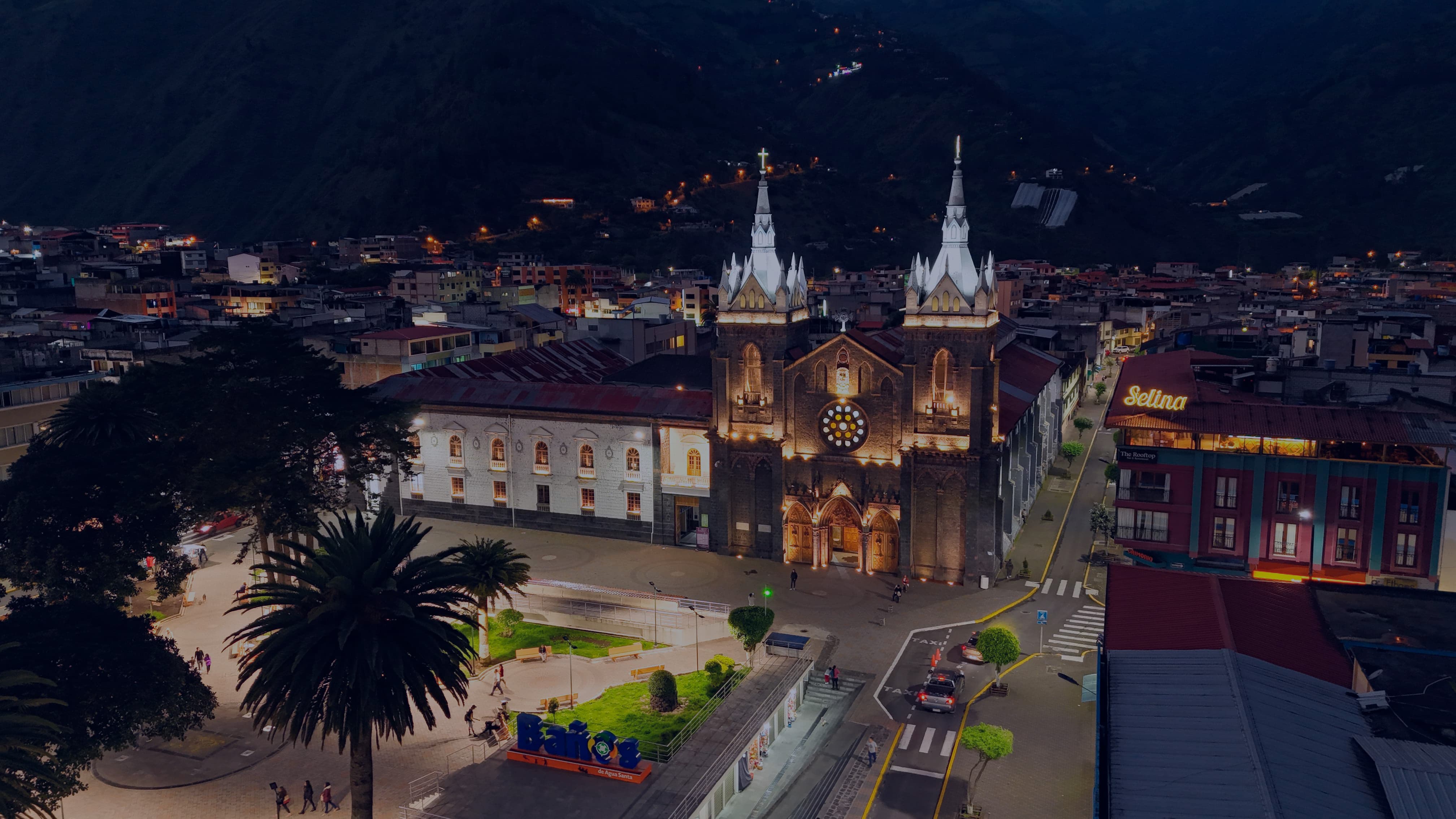
Tungurahua or “Throat of Fire” is the most attractive active volcano of Ecuador located in the Cordillera Oriental of the Equatorial Andes, between Chimborazo and Tungurahua provinces. The last eruption started in 1999 and continues until today. You can comfortably stay at “Baños de Agua Santa” (Holy Water Baths) city during your visit, which lays at the volcano’s slope. Tungurahua is also known as “Black Giant” and, in local indigenous mythology is allegedly referred to as Mama Tungurahua (“Mother Tungurahua”), it raises up to 5.023 meters above the sea level, it has 16 km in diameter and is located 33 km South-East of Ambato city. Baños city is located at the volcano’s slopes, five kilometers to the north and offers different services of accommodation and activities, like visiting the Tungurahua. The mountain is part of the Sangay National Park, declared by UNESCO as Natural World Heritage. On July 14, 2006 Tungurahua had its most violent eruption since 1999, letting escape a smoke column of 15 km, composed of ash, steam and rocks, which headed to the Pacific Ocean and was clearly visible in satellite photos. Then, on August 16, 2006 an eight kilometer column of lava emerged from the crater, where huge quantities of ash and fiery rocks escaped. The whole province of Tungurahua, as well as the cities of Riobamba and Penipe in the province of Chimborazo, were covered with layers of rock and ash. The flora is represented by some species such as: chuquiraga, moss campion (almohadilla), achupalla, pega-pega, aliso, bromelias, arrayán, pumamaqui, frailejones, mortiños, motilón, orchids, polylepis, chocho and rosemary. In the proximity of the volcano you can see rabbits, paramo wolves, cougars, spectacled bears, blackbucks, frogs, guinea pigs, tapir, hedgehod, hares and deers. Privileged place for bird watching: doves, blackbirds, swallows, quilicos, chirotes, condors, hummingbirds, band-tailed sierra finches, indigo buntings, hawks and eagles. The reactivation process of the Tungurahua volcano, every 80 years, is a unique attraction because under normal conditions of visibility you can see how the mountain smokes or expulses lava. The indigenous believe that the "Taita Cotopaxi" is married to the "mother Tungurahua". It is easy to climb but with a specialized guide.
143.88 Km.

Las Lajas Waterfall
Las Lajas waterfalls are located in the Santa Clara Canton, San José Parish at Km. 28 of the Puyo-Tena road, a few meters from the main road with an average temperature of 25ºc. How to get to Las Lajas Waterfalls in Santa Clara Canton from Puyo If you leave Puyo you must take the Amazon trunk towards Santa Clara, on the Puyo-Tena road, the trip lasts 30 minutes, on the main road you will find a sign with the indications of the place, from there you must go by a third-order highway which has a distance of 1 km. Upon arriving at the place you will find the parking area and a person in charge of providing you with all the information and recommendations so that your entry and stay in the place are pleasant and above all safe. From the place of the parking lot you must walk along a bleachers path with around 250 steps, until you reach the rest area and viewpoint of these beautiful waterfalls. In the place there are 2 waterfalls that are accessible by means of cement paths with metal handrails, from this way you can access both the first and the second waterfall and in both you can take a refreshing bath. Activities and Services you can find in Las Lajas Waterfalls Observation of flora and fauna Trekking Waterfalls Natural spa Feeding Important recommendations at Las Lajas Waterfalls Comfortable clothes Sunscreen Repellent Photographic camera Rubber boots Binoculars Water Poncho Umbrella Office Hours in Las Cascadas Las Lajas Wednesday - Sunday from 08:00 AM - 17:00 PM Access Costs to Las Lajas Waterfalls Adults $ 1.50 Children $ 0.75 Contact phones with Las Cascadas Las Lajas 032 440-737 0998073199/0995758581
143.95 Km.

Jars of the Anzu River
The Tinajas del Río Anzu are one of the best places that you should not miss. This is by far the favorite place for nature and adventure lovers, it is located 14 kilometers from the cantonal head, to access this attraction you have to take the second-order road that leads to the 24 de Mayo neighborhood; If you do not have your own vehicle, you can rent a van in the central park of Mera, the approximate cost is $ 20 round trip. Already on the site you have to take an ecological path where you will walk for approximately 1 hour, during which time you can enjoy the surroundings and the great variety of flora and fauna typical of the rain forest. The attraction is made up of a set of rock formations next to the Ánzu river, which in the way of natural jacuzzis allow the visitor to take a well-deserved rest while relaxing in the crystal clear waters. Remember that for your safety the journey must be under the accompaniment of a local guide, do not forget to bring light clothing for the journey and warm for the return, the camera is essential in this type of adventure, the photographs and videos you capture of that Crossing will be the best testimony to share with your friends of the magic of that place hidden in the middle of the jungle. More information with our local guides. Frankie Lugo: 0995227433 Henry Sánchez: 098437879
145.90 Km.

El Kilo Waterfall
Located on the left bank of the Baños - Puyo road, in the El Kilo sector, this natural attraction constitutes one of the favorite destinations for family tourism, not only for its scenic beauty but also for the ease of access. Reaching this attraction is quite easy, the journey of approximately 10 minutes is made through an ecological path that runs along the right bank of the El Kilo river; Its main attraction is the 3 waterfalls that form the waterfall of approximately 30 meters in height, which together with a natural pool of crystalline waters are the perfect complement to enjoy a restful afternoon with family or friends. If you travel in your own vehicle, do not worry, the place has a large and secure parking lot, the cost of admission is $ 1 for children and $ 2 for adults, attention is from Monday to Sunday, from 9 a.m. to 6 a.m. pm. Don't forget to bring your camera and warm clothes for after the bath. More information at the following contact. Roberto Zurita 0993624869
146.16 Km.

Caverns of the Anzu
Caverns of the Rio Anzu, an experience at another level One of the iconic attractions of our canton is the set of caves of the Ánzu river, natural formations located on the road that leads to Colonia 24 de Mayo, north of the cantonal head, the journey by vehicle takes around 30 minutes for a Second order route, if you do not have your own vehicle, you can rent a van in the central park of Mera, the cost of round trip is $ 20. Once there, you will be able to enjoy a wooded environment where, through its trails, you can easily spot birds such as the colorful Cock of the Rock (Rupicola peruvianus) and a wide variety of orchids and bromeliads. Going into the caves can be an overwhelming experience, however, the local guide will provide visitors with the necessary equipment so that the underground tour is guaranteed; Inside the visitor will advance through narrow spaces as well as through large rooms where they will be able to observe stalactites, stalagmites and species typical of underground ecosystems. The main attraction of this place is the World Cup, a stalagmite approximately 1 meter high whose shape reminds us of the famous soccer world cup trophy. The visit to the attraction must be made with the accompaniment of a guide; Due to the difficulty of the journey, the tour is not suitable for people with disabilities, older adults or children under 8 years of age. Remember that outdoor activities are best enjoyed with sportswear and of course you can not miss our camera. For more information contact our local guides. Frankie Lugo: 0995227433 Henry Sánchez: 098437879
146.23 Km.

Amazonian viewpoint of the Pastaza River
This attraction is located at the entrance to the Mera canton, in the sector known as the birds, on the right bank if you are traveling in the Baños - Puyo direction. The site is ideal for lovers of landscaping, photography and adrenaline, to the spectacular panoramic view that forms the Pastaza river canyon is added the impressive swing whose pendulum movements lift visitors hundreds of meters above the void of the imposing canyon. The service is from Monday to Sunday, from 9 a.m. to 6 p.m., the cost for children is $ 1 and for adults $ 3, food, parking, guard and souvenir sales are offered in the place. More information on their Facebook page: Mirador Amazónico
146.63 Km.

Urbina Train Station, Lookout & Museum
The Urbina parish station is the highest in the route of the Ecuadorian railway. It is located at 3,600 meters above sea level, at the foot of the Chimborazo and Carihuairazo volcanoes. In the Urbina station, as it is known, there is an Interpretation Center or Ice Museum. Its main character is Baltazar Ushca, of the Puruhá indigenous nationality, known internationally as "the last ice maker of Chimborazo". He tells the tourists how he extracts fossil ice from the volcano's glacier and goes down to sell it in the markets of Riobamba, for the preparation of ice cream and fruit juices. The life and unique activity of Baltazar has been recorded in films such as "Los hieleros del Chimborazo", in documentaries and videos of the most important international television networks. The ascent to Chimborazo is another option, following the route of Baltazar. It is the "Walk of the Ice cream Makers". The landscape with its diverse colors can be appreciated from the height of this viewpoint. Due to the low temperatures, which can reach zero degrees, warm clothes will be of great help. The High Mountain Refuge of Urbina offers accommodation. It is the center of operations for visitors to learn about the culture of the Ecuadorian Andes. As in every place of the moor, paper trees grow here, alpacas, grazing animals such as cows and horses and the frailejones can be seen. Nature photography is an unavoidable activity. In the recreation of a small hut, the habits and culture of the Chimborazo Indians are represented. Next to the stone fire, the guinea pigs and rabbits with a good supply of grass to feed them. The mat serves as a bed. In the souvenir shop there is how to buy scarves, ponchos, gloves, wool hats, handicrafts. The route is not complete without visiting La Moya, a community of indigenous Puruháes, dedicated to community tourism. To get to Urbina by train, you must board the train in the city of Riobamba. The Riobamba station has a museum about the history of the railway. It explains through a model the obstacles that had to be overcome at the end of the 19th century and the beginning of the 20th century, in order to unite the sierra with the coast. Because of these difficulties, the Ecuadorian railway came to be called "The most difficult train in the world". The Avenue of the Volcanoes unfolds all its splendor. On a clear day, from Riobamba you can see the volcanoes Sangay to the southwest, Altar to the east, Chimborazo and Carihuairazo to the northwest and Tungurahua to the north.
148.04 Km.

Dedalma Butterfly Garden
The Dedalma Butterfly Garden is a suitable place for lovers of wildlife, in this place you can admire the entire process of breeding and reproduction of some varieties of butterflies and insects in the area. This site has a range of plants suitable for the adaptation and reproduction of countless species of butterflies, where these insects are found as if they were in their own habitat and thanks to the care of their owners, they receive all the protection for their upbringing and reproduction, since today many of these species are in danger of extinction due to the large number of people who hunt these beautiful butterflies. This site is the ideal place to relax and get into perfect harmony with nature and above all enjoy the beauty and charm of observing that range of colors, sizes and variety of butterflies. If you visit the Mera canton, do not forget to go to the Dedalma Butterfly Park and enjoy the attractions they have for you. How to get to the butterfly garden? 16.5 kilometers from the center of Puyo. In the cantonal capital of Mera, kilometer 15 via Baños, diagonal to the Mera Dam, 30 minutes from Puyo, a popular citadel. Activities and services: Butterfly Observation Research Entomological Information Sale of Crafts Jungle Tours Schedule: Its office hours are Monday through Friday from 9:00 a.m. to 5:00 p.m. Entry Cost: National: $1.00 Foreigners: $2.00 Children under 12 years: Free admission
148.09 Km.

Rio Tigre Tourist Complex
The Dam of mera, as it is called locally, is an obligatory meeting place for national and international tourists who visit Pastaza. This dam is recognized as a modern spa that has all the basic services that tourists require for their greatest enjoyment and safety. The slides that flow into the river are the main attraction of the place. If you like sports activities, there is a volleyball court, as well as a beautiful tree house, and ecological trails, as well as changing rooms and basic services. There are guardianship services, and private parking for your vehicle. Additionally, they are offered for an additional fee, food services, sauna, Turkish, and hydro massage. On site there are shops selling local crafts, clothing and accessories. How to get to the resort? 16.5 kilometers from the center of Puyo. In the cantonal head of Mera, kilometer 15 via Baños, 30 minutes from Puyo, by car. From the central park of Mera, 800 meters following Velasco Ibarra street. Activities and Services: Swimming slides Tree house Sale of Crafts Feeding walks Sauna and Turkish additional services Entrance cost: Adults $1.00 Children $0.50 Persons with special abilities $0.50 Recommendations: Cap Repellent Photographic camera Swimwear.
148.22 Km.
We have 413 tourist attractions listed in Ecuador.