

Ecuador travel
Tourist attractions in Ecuador
Explore the tourist attractions of Ecuador.

Aguarongo Forest
Interest: Nature Type: Tropical Mountain Forest Friendly to: Children, families, seniors Relevant categories: Municipal protected area The Aguarongo forest since 1985 protects the water resources of the canton of Gualaceo and the parishes of San Juan, Jadán, Zhidmad and San Bartolomé, east of Cuenca. It is an important natural instrument for the environmental education of the human communities that live in its surroundings and of the tourists that visit it. Andean forest, paramo plants, and shrubs grow on 2,080 hectares between 2,280 and 3,320 meters above sea level. Aguarongo is an undulating volcanic plateau. In the interior of the forest proliferates the aguarongo that gives its name to the place, the flower of the Andes or chuquiraua, the valerian, the laurel, the pumamaqui, the gañal, orchids, and numerous shrubs. Wild animals such as spectacled bears, deer, ocelots, guinea pigs and rabbits find refuge here. It is an intact space of nature with magnificent sunsets. To manage the site, in coordination with the GAD's and nearby communities, offering adequate attention to the visitor, the Environmental Management Center (CGA) carries out tasks of education and interpretation of its natural resources. It offers food and lodging services. Ideal for booking and hiring training events in its multipurpose room or overnight cabins. In line with its institutional objectives, the Center has a network of basic services that are environmentally friendly: a drinking water plant and heaters that run on electricity generated by solar panels. There are 6 trails to go into the thicket. At some points of these trails there are viewpoints with panoramic views of the Paute River Valley. The Aguarongo Protected Forest and Vegetation Area (ABVP) was created on July 30, 1985. Source: Fundación Municipal Turismo para Cuenca
309.54 Km.

Turi Viewpoint
The name of Turi (parish parish), comes from the indigenous word kuri, which means gold. It is located 10 minutes from the city center. It was founded on February 5, 1853 and born to ecclesiastical life on March 31 of the same year. The mountain of Turi, according to Inca history, was a place of worship of the gods. It has a panoramic and unique view that allows you to observe the city in all its splendor, this place is a must stop for domestic and foreign tourists; It is known as "the balcony of Cuenca." Turi has always been part of the city, and the city without Turi is incomplete, because the character of Cuenca is marked by the mountains that surround it. Its image is that of a viewpoint, but Turi also has other images: it is its own landscape, it has its own culture, an artisanal economy, and its own architecture of Cuenca located inside the parish. The Turi area comprises three well-marked spaces: Turi-Centro, Ghuzho and Punta Corral. The first two constitute mixed cultural areas, while the third is indigenous. How to get to the Mirador de Turi in Cuenca? To get to this place, there are several alternatives, buses, taxis or tourist transport. From the Historic Center, Turi is 5.3 kilometers away. From Calderón Park, the double-decker buses are the transport for the tour of the city and whose final destination is Turi. The parish has an element of great cultural significance, the Lord of Bethlehem Crucified with four nails, embedded in the mountain, carved in stone that recalls the romantic style of the time. This special place, which is located above the parish house, was a very important Cañari shrine. According to previous tourist experiences, your visit at 5 and 6 in the afternoon is of great satisfaction; At this time we find a lot of movement in the commercial and nightlife venues such as bars and restaurants. Among the iconic aspects of Cuenca are the New Cathedral and several church domes, the center, the lower part, the great avenues, parks and green spaces that confirm the beauty of this city, declared Cultural Heritage of Humanity. Tourists, thinkers, artists, lovers visit this place to clear their ideas and enjoy the panoramic view it offers. Source: https://cuencaecuador.com.ec/es/blog/mirador-de-turi-5-actividades-para-disfrutar https://ec.viajandox.com/cuenca/turi-A141 http://viviramiestilo.com/viajes/como-llegar-al-mirador-turis Images: https://commons.wikimedia.org/wiki/File:Cuenca_desde_el_mirador_de_Turi.jpg https://commons.wikimedia.org/wiki/File:Panor%C3%A1mica_desde_Turi_de_Cuenca_(Ecuador)_2.jpg https://commons.wikimedia.org/wiki/File:Virgen_en_Turi_Noche.JPG
311.19 Km.

Volcanic Springs & Spas at Baños of Cuenca
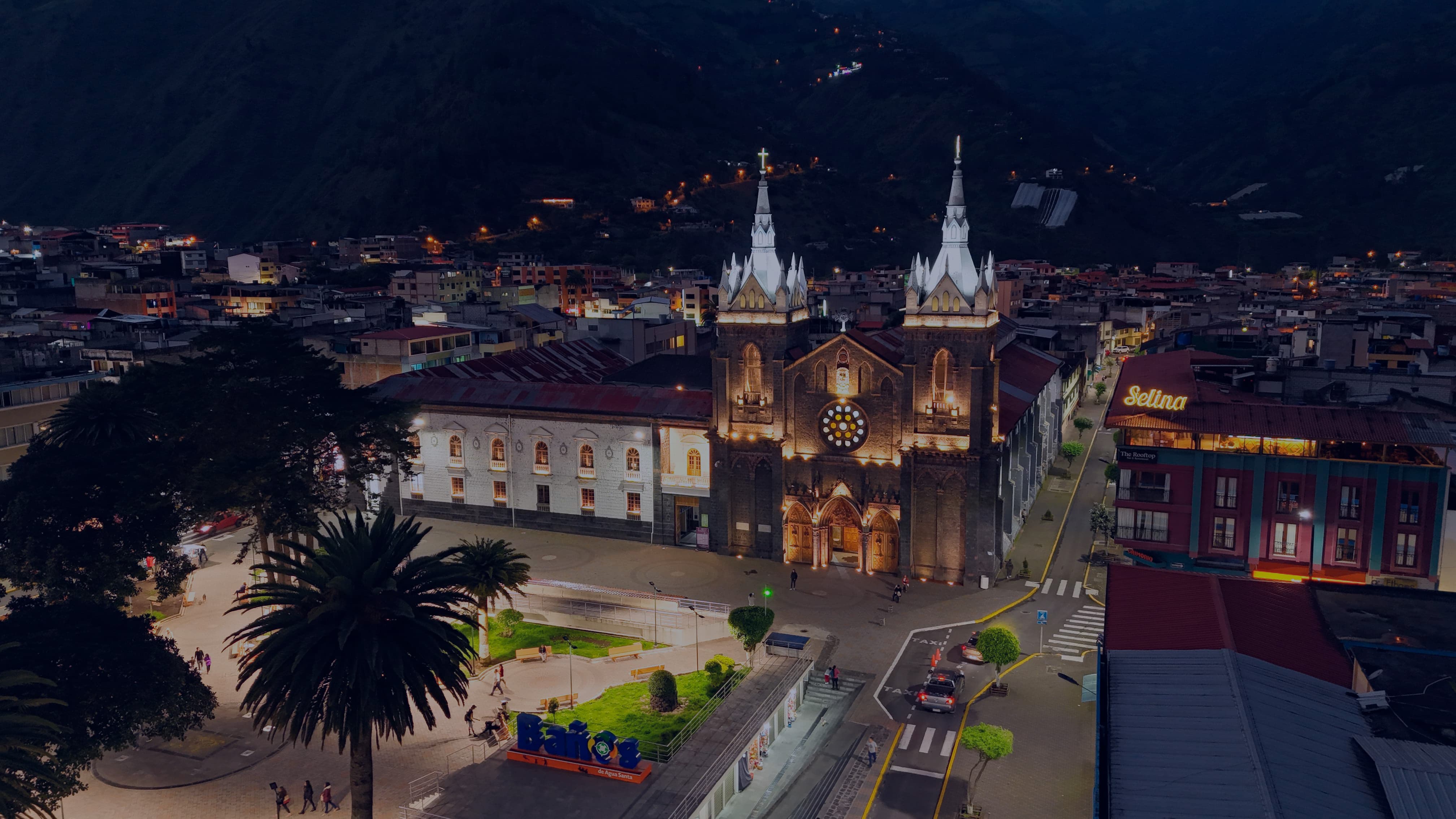
The rural parish of Baños, southwest of the city of Cuenca, is considered one of the most attractive places to rest and recover. Almost eight decades have passed since the use of the thermal waters in this area for recreational and healing purposes began. Baños preserves its image of a typical Andean rural town, dominated by its imposing celestial temple consecrated to the Virgin of Guadalupe. The church was built by miners or community workers in the 1950s. It is an imitation of the New Cathedral, in the center of Cuenca. The upper part of the parish is a viewpoint of Cuenca. The 8th of September is the feast in honour of the Virgin of Guadalupe. However, everything changed in the town with the modernization of its spas with thermal volcanic waters, inns and restaurants of typical food. There are different offers to enjoy services such as hydromassages, professional massages, surface and underground pools, contrasting hot springs, mud caves, Turkish baths, among others. In the gastronomy, the famous “empanadas de viento” (wind pie) stand out. The gastronomic tradition that also makes Baños famous, was started by Rosa Nasipucha. Nowadays there is a varied offer of food in dozens of businesses. The thermal waters of Baños are attributed with curative properties. These waters have their origin in "La Loma de los Hervideros" (the Hill of Boilers). The water comes to the surface at a temperature of 75°C. After cooling them, they are used at about 36 to 42°C. José Barros Alemán, an elderly man from the parish, remembers that the spa service was started by the family of Ricardo Durán Brito and Matilde Alemán, who founded Balnearios Durán in the 1940s. Mr. José remembers that people used to walk from Cuenca, because there was no transport. They were groups of young people from schools and universities, who went to the only place in Cuenca with a 25-meter swimming pool to practice swimming. Then the pools were increased. And more recently, more and more spa services specialized in the area of well-being and beauty have been opened, such as Piedra de Agua or Novaqua Spa.
312.10 Km.

Malecon of Montanita Ecuador
The Montañita boardwalk was built with materials that are friendly to nature. The infrastructure is above the rock that rose as protection from the ravages of the sea. It comprises an extension of 400 meters of clay pavers and teak wood was used for the railing. The corridor is 2.5 meters wide. It has lighting, stairs to enter the beach, benches, sanitary batteries, pergolas and planters. In two sections of the boardwalk stand out the same number of surfboards with the caption: "I love Montañita". The idea is that they are one of the reference points for tourists. While you travel the Malecón you can enjoy a relaxed monento and share with friends or family the majesty of the sea that collides with its large waves, which are preferred by domestic and foreign tourists to learn and surf. In this place there are rest areas where it is very common to find tourists talking peacefully and without any worries. The busiest place in the sector and where every tourist who visits Montañita must go is the Malecón, here you can listen to dialects from all over the world, depending on the season you will meet Chilean, Argentine, Asian, French, German tourists and much more. In the reocrrido of the boardwalk there are varied lodging options in Montañita, such as hotels and hostels of different tastes and prices, which offer their services with a privileged view towards the sea. We recommend you to wear sunglasses and sunscreen to avoid a burn, and in this way you can enjoy this beautiful place to the fullest.
312.19 Km.

Community of Bacpancel
A few minutes from the parish seat of San Juan is the Bacpancel Annex. In 2009, its inhabitants decided to organize and develop a community tourism initiative. Today, the Artisan and Solidarity Tourism Association of Bacpancel receives visits from the country and the world, to showcase the attractions of the community. As in many other places in Azuay, toquilla straw weaving supports the local economy. They make hats, crocheted bags, cholas figures, jewelry boxes, baskets, cup holders, placemats, decorative bottles, baskets, napkin rings, containers. The Artisan Association practices fair trade with the 30 women weavers, from whom they buy their products at a good price to sell them in stores in Quito and Cuenca. They have the experience of having exported to Italy and Brazil. Other crafts they are dedicated to are embroidery and weaving. Bacpancel is a typical town of the Ecuadorian mountain range. Located 30 minutes south of Gualaceo. It can be reached by the road to San Juan. In the landscape, its low hills and houses built with traditional materials such as tiles and adobe stand out. They have a solid proposal of community tourism, which is executed with tours to the Pishi hill, the Tasqui waterfall, the Tari viewpoint and the Lanacocha lagoon. But the strength lies in the experience of the customs and traditions. Tourists can get involved in the process of planting and harvesting. Or live the experience of the pampas. It is a communal meal, with food placed directly on cloth in the middle of the field. The pampamese is the maximum expression of solidarity, after working together. The gastronomic offer of the site includes guinea pig with potatoes, mote pata, barley rice, locro de zambo and barley peeled with bacon. Other activities promoted are traditional dances, natural medicine, livestock for cheese production and organic gardens with vegetables and fruit trees Its main celebrations are held on 24, 25 and 26 May in honour of the Virgen del Auxilio, with a flag, a game of skirmish and pampamesa.
312.92 Km.

Pumamaqui Thermal Springs
The thermal waters have been used for millennia for the benefit of human beings. Different cultures have found in them a method to recover the health of the body and the mind. The Andean peoples were no exception. The Ecuadorian mountains have an exceptional richness in geothermal waters, which were already known and very popular since the Incas. A few kilometers southwest of Cuenca, on the road to Soldados, are the Pumamaqui Hot Springs. This is a recent undertaking, considering other more developed and older sites in the country. In Pumamaqui, the waters spring up naturally from the ground. They are health bubbles. It has pools of different temperatures, healing therapies of cold/hot contrast, Turkish bath and clay. It is a primordial space to free the mind from the stress of daily life and routine. To leave all the problems aside. The landscape around the Yanuncay River contributes to this goal. Located in the valley of Soldados. The name Pumamaqui comes from the fact that a kind of tree grows in the surroundings, whose leaves have the shape of a lion's paw. Pumamaqui then is translated like paw of the puma. To get to the spa, you must take the San Joaquín-Soldados-Chaucha road. At km 23 there is an entrance sign. Then a hundred meters of walk. It is five minutes away before reaching the community of Soldados. Pumamaqui is a source of medicinal treatments. The beneficial characteristics of its waters are due to their alkalinity and their composition based on sodium, potassium, and calcium ions. They give a relaxing effect. Recommended to combat a huge list of ailments: high blood pressure, rheumatism, gout, joint, muscle and bone injuries, bone decalcifications and malformations, bronchitis, surgical sequelae, arthritis and arteriosclerosis; respiratory and ear disorders, insomnia, nervous diseases, skin diseases, paraplegia and other ailments. Its infrastructure is simple. Enough for those who are looking for a different experience. At the hot springs, the water is channeled into pools built with stone and cement. It has dressing rooms and bathrooms. The service is complemented with typical dishes. Visitors can request vegetarian food, pizza and drinks.
317.33 Km.

The Soldados Route with the Local Community
Soldados, a valley of glacial origin, southwest of Cuenca. The name identifies a hill at 3,954 meters above sea level on the southern border of Cajas National Park, a river, a community, a moorland, and an hacienda. All with exceptional attractions. Especially the landscape. The toponym Soldados has its origin in some stones in a vertical position that seem to be soldiers in formation and in uniform, which are found in the mountain of the same name, according to the inhabitants of the sector. Soldados borders the Nudo de El Cajas mountain range. Its landscape is dominated by high and steep mountains. The vegetation is of herbaceous moor, Andean forest and chaparro forest. In the community of Soldados live 40 families organized around a church and central square. They are farmers and cattle ranchers by tradition. They have found in community tourism and the sale of handicrafts a new source of income. For tourism there are several options. Hiking or horseback riding with native guides to the 7 lakes of Estrella Cocha. You can also ride or walk to the lagoons that give rise to the Yanuncay River, in the Gal-Gal sector. There you can visit a cave and the polylepis forest. Landscape photography is another option. It is 2 days of camping. Dozens of cyclists pedal on the weekends to visit the town of Soldados and the parish tourist circuit "San Joaquín-Río Yanuncay Route". During the tour, 20 restaurants and typical food stores serve the visitor. An obligatory stop is the Ecomuseum of the Yanuncay, with six rooms that exhibit 5,000 wooden sculptures and stone collections. You can also visit a chocolate factory, the basket workshop or the orchards of the Agricultural Producers Association. There are places to buy farm eggs, raw milk and cheese. There is a lookout point at Verde Llano, which can be reached after a three-hour walk through forests that are home to a diversity of flora and fauna. Included in the route are the thermal pools of San Vicente, where sport fishing is practiced, and the thermal waters of Pumamaqui.
319.66 Km.

Coangos Shuar Community
Kuankus is the aboriginal name of a river and the small Shuar community that guards the entrance to the authentic Cave of the Tayos. The unusual interest of researchers, adventurers and outsiders from all over the world for the cave, motivated the indians to organize themselves legally to manage it from tourism. A series of services have been developed in recent years in Coangos (Spanish name), by their community members. Traditional cabins and a system of showers are available to visitors. But mainly, each group that arrives is received with a dinner prepared by the typical food restaurant to later witness a show of traditional dances that represent war, marriage or gratitude to mother earth. Other options include hiking trails through the jungle or rafting down the Amazon rivers with modern equipment and implements. This completes an offer with all the resources and benefits for visitors. For the Shuar, community tourism means responsibility with the environment and sensitivity towards all forms of life. This is one more of the dozens of community tourism experiences that are growing in the Amazon region of Ecuador. With promotion and diffusion, Coangos strengthens its image as an ancestral site, seeking to position itself as an enchanting and magical place. The local ethnic population wants to achieve with tourism a form of income and sustainability, leaving behind the past when outsiders took advantage of the myths around the Cave of the Tayos. Coangos is a small town of only 80 inhabitants, located between the Santiago and Coangos rivers. However, the territory it possesses is extensive and is divided into Coangos Alto and Bajo, Cueva de los Tayos and Puerto. The local means of access are by canoe, horse or on foot because the population is in the middle of the Amazon jungle.
320.78 Km.

Ayangue
Ayangue is a commune in Santa Elena known as "The Pool of the Pacific", due to the clear waters of its beaches, the coral reefs and the charm of this small city. Ayangue Beach is known for its clear, warm waters, pristine coral reefs, and small-town charm, making it a great spot for scuba divers. With wide sands bordered by two cliffs that interrupt the sea, Ayangue invites you to rest and feel welcome. The restaurants offer you the most exquisite lobsters, shrimps, octopus, crabs, to delight your palate.In Ayangue you will find a large number of fishing boats that offer rides into the sea, which will allow you to have another perspective of the paradise you are visiting. The population has historically been dedicated to artisanal fishing and the elaboration of handicrafts. Ayangue is a commune of the Colonche parish, Santa Elena, located 42 km from the Ballenita Terrestrial Terminal and 150 km from Guayaquil.The period between June to September humpback whales arrive at the coast of Ayangue to reproduce and mate. Location of Ayangue Located in the province of Santa Elena, 150 kilometers from Guayaquil, bounded to the north by the San Pedro Commune, to the south by the Palmar Commune, to the east by the Colonche parish and the mountain range of the same name, and to the west by the Pacific Ocean.
322.19 Km.

Ferbola's Organic Farm
Ferbola Organic Farm is located in the middle of a great natural landscape: the canyon of the Oña River. It is in the parish of Susudel, in the Oña canton, in the south of the Azuay province in Ecuador. It is a pioneer farm in the production of pesticide-free food. Visitors can learn about organic vegetable, fruit and cereal crops. But this is also an ideal site for the visitor who likes outdoor activity and nature. The farm offers accommodation and food service for 15 people in its old farmhouse. Camping for 150 people. Guided tours of up to 1 day to Susudel or Saraguro can include hiking, horseback riding, 4x4 activities, bird watching (including Andean condor sighting), exploration of colonial houses, archaeological remains or visits to waterfalls and lagoons. The farm prepares dried beef or pork, dried chili, dried chili in olive oil, dried fruits (mini banana, fig, apple, fruit tea, pineapple, apple, uvilla, orange, strawberry), stevia, milk sweets, coconut milk, apple, strawberry, zambo, blackberry and pomarrosa. Meat, chili and dehydrated fruits are obtained through the "charque", an Andean method of food preservation known since pre-Columbian times. Another line of work is the pickling of peppers, onions, pickles and cheeses. The cultivation of agricultural species is achieved through permaculture. An extension of the farm is the Ferbola Caballo and Café for country side food, with visits to orchards, horseback riding and walks. Km 16.5 Via Cuenca - Giron. Over the years and the consolidation of an image, the goods produced by this organization can be found in shops, supermarkets, craft and agricultural fairs in Cuenca and Ecuador. This family enterprise strengthens food sovereignty and the production of agro-ecological goods. Ferbola was born as an initiative of Fernando Moscoso's family in 2007. He was the heir of an old farm in Susudel, which belonged to his grandfather. The land was in the hands of his ancestors from generation to generation, since the time of the Colony. Ferbola is also a model of sustainable and environmentally friendly community tourism as the geography and culture of Susudel are ideal for it. In this parish stands one of the oldest churches in Ecuador.
326.73 Km.

El Chorro (Waterfall) of Giron
The "Chorro" is a colorful waterfall that is located in the canton Giron, province of Azuay. The attraction is formed by three waterfalls, which in total add up to 70 meters high. The most accessible area has a wall through which the water falls in the form of a curtain and a natural pool of a few meters deep. Behind this first segment of the Chorro there is a cave. The most daring venture into it. Only a few years ago, the Chorro was a pristine place, with some difficulty of access. But on the initiative of the Giron municipality and also of private organizations, certain infrastructures and services have been developed that make the visit to the place more comfortable. Now it has paths, footbridges, signs, night lighting, and a tourist inn with family cabins. Guided excursions are also possible, depending on the level of difficulty to be reached. Other alternatives are horseback riding, photography, mountaineering, canopy. Located 5 km northwest of Giron, it is accessible by private car, public transport and on foot (after a 30 minute walk). The climate is cold. There is a dense vegetation composed of a variety of mosses, ferns and orchids. The waters of El Chorro originate in the sector of Sombrereras which is 3,600 meters high. They give sustenance and are part of an ecosystem that has 64 species of hummingbirds, deer, pumas and condors. It is also considered a place of legend. Enchanted waterfall with waters that have the property of healing body and soul. Others believe that there is a hidden treasure or that at the bottom of its pool there is a gold pan.
337.10 Km.

Enterprising Women of San Gerardo
Mujeres Emprendedoras is an organization of women weavers and natural health. They have their headquarters in the parish of San Gerardo, 11 km by car to the east of Giron. They are 11 women from San Gerardo and Victoria del Portete, two rural parishes in the province of Azuay, determined to cooperate through popular and solidarity economy activities, to improve the living conditions and guarantee the subsistence of their families. They offer the public a variety of products. Embroidery with thread and ribbon, dolls, colored pillows that can serve as pincushions, shawls, wallets, clothing, uniforms. Another line of work is native herbal remedies and cosmetics. Healing ointments for flu, camphor oil, flower extract for bad air or the evil eye, oatmeal and honey soaps. The popular initiative is supported by a mining company and public and private institutions. They hope to continue growing, that more women will support them and become economically independent from their husbands. At the San Gerardo Infocenter they were trained in the new Information and Communication Technologies (ICT), Entrepreneurship module. They are able to market their handicrafts, pharmacy products and natural cosmetics nationwide. Their official Facebook page is @Asociación Mujeres Emprendedoras de San Gerardo, where they promote all their activity. They are another successful example of a business model that inspires others to replicate this experience. The rural parish of San Gerardo in the canton of Giron is the area of influence of the Loma Larga mining project and has a population of approximately 1,000 inhabitants who are mostly engaged in agricultural work. It has health, road, sanitation and education infrastructure and services.
338.98 Km.
We have 413 tourist attractions listed in Ecuador.